


Richard Fleischer
|
Read more
at in70mm.com The 70mm Newsletter |
| Written by: Rick Mitchell, © 2006, Universe rights reserved. | Date: 26 May 2006 |
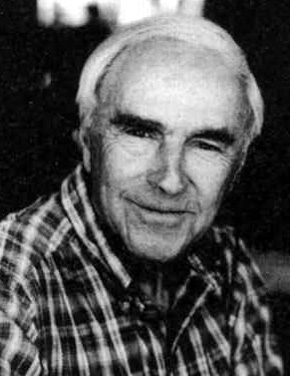 Because he chose to work mostly as a director for hire within the studio
system, Richard Fleischer was never given the respect due him by
auteurist critics ignorant of a director's true role in film production
or the intricacies of studio politics. Because he chose to work mostly as a director for hire within the studio
system, Richard Fleischer was never given the respect due him by
auteurist critics ignorant of a director's true role in film production
or the intricacies of studio politics.Fleischer's memoir "Just Tell Me When To Cry" (New York: Carroll & Graf Publishers, ©1993) rarely gets into detail about his role in either the writing of many of his films and doesn't mention his involvement in their editing, and the flaws in some of them can be traced to producers or studio executives. Yet, a look at a selection of his films (unfortunately, I have not seen them all) reveals a definite and recognizable personal style in both his handling of actors and his mis-en-scene. Fleischer took a low-key understated approach to the performances in his films. While this was fairly standard in Hollywood films in the Forties, when he started out, it was something of a house style at RKO Radio Pictures, where he began his career, as can be noted in the films of his contemporaries at the studio, Edward Dmytryk, Nicholas Ray, Mark Robson, and Robert Wise. Even where the role called for a certain flamboyance, such as Marie Windsor's in "The Narrow Margin" (RKO; 1952) or Orson Welles´ in "Compulsion" (20th Century-Fox; 1959), there is a restraint that enhances the character's believability rather than making it an exercise in scenery chewing. At the same time, he allows or encourages an underlying and appealing sense of humor in many of the actors¹ approaches to their roles, a lightness that makes the most outrageous of plot situations acceptable. This is best illustrated in the blasé insouciance of the scientists and military men in "Fantastic Voyage" (20th Century-Fox). This may also be the reason why Fleischer¹s more fantastic and adventurous films work as well as they do. Like Robert Wise, he took such projects seriously, and not only has his "20,000 Leagues Under The Sea" (Disney; 1954) and "The Vikings" (United Artists; 1958) never been equalled or surpassed, to date no one seems to have tried to do so. In retrospective, what has long been considered his best known big budget disaster, "Doctor Doolittle" (20th Century-Fox; 1967), comes off as more a victim of bad timing than an unwatchable film. Even "The Big Gamble" (20th Century-Fox; 1960), the last three-quarters of which Fleischer claims were written by producer Darryl F. Zanuck, holds the attention despite the feeling that it would have worked better set in the Twenties or Thirties. |
More
in 70mm reading: Historical Overview Of Wide Screen Robert Wise - a rememberance Internet link: |
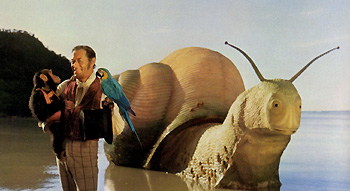 "Doctor
Dolittle" Fox 1967 "Doctor
Dolittle" Fox 1967Though he came to the attention of RKO through his off-Broadway stage work, and did shorts and documentaries for them in New York before being brought out to Hollywood, he was the son of legendary animation pioneer Max Fleischer, and had a strong understanding of the importance of a film´s visual side that he particularly brought not only to his wide screen movies, but to one of the surprises in the 2003 3-D Expo, "Arena" (MGM; 1953). Fleischer¹s wide screen films, like those of Robert Wise and David Lean, are textbook examples of how the format should be used. While the compositions and staging of "20,000 Leagues Under The Sea" may be attributed to Disney and his storyboard artists, the continuity of his approach in later films, including "intimate" dramas like "Compulsion" and "Crack in the Mirrior" (20th Century-Fox; 1960), done in collaboration with different production designers and cinematographers, suggest these images came from Fleischer. Although there are contemporary "pretenders" to the action-adventure genre that directors like Fleischer, Don Siegel, Phil Karlson, among others, seem to do so effortlessly, none of them, especially not Peter Jackson, have come close to even their lesser efforts. Those directors came from a different time and a different, more innocent sensibility. Fleischer was the last of a noble breed and it¹s doubtful if his, or their, like will ever be seen again. |
|
|
Go: back
- top -
back issues
- news index Updated 21-01-24 |
|