


That's Entertainment |
Read more at in70mm.com The 70mm Newsletter |
| Written by: Rick Mitchell, Hollywood, USA. | Date: 30.08.2010 |
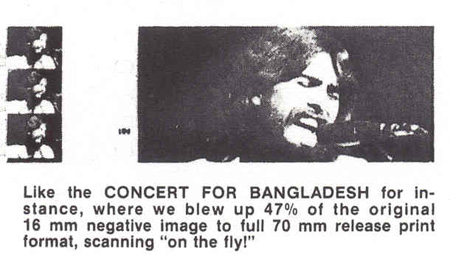 Film Effects of Hollywood, Inc enlarged a 16mm print to 70mm. Unheard of at that time. This is from the advert. Editors collection Film Effects of Hollywood, Inc enlarged a 16mm print to 70mm. Unheard of at that time. This is from the advert. Editors collectionIn 1967, when MGM Laboratories made the first 70mm blow-up from 35mm non anamorphic (spherical) photography, it did so to the full projected 2.2:1 width of the 70mm frame. Unlike conversions from 35mm Technirama or 35mm anamorphic photography, in which essentially all the information on the original frame is transferred, here only about two/thirds of the image is used, resulting in images that are not quite sharp and very grainy. Yet, the results were considered acceptable at the time and over the next decade a handful of such films were blown up to 70mm, more for stereophonic sound than high quality picture, including "The Concert for Bangladesh" (1972) for which 70mm prints were made directly from the original 16mm color negative! |
More in 70mm reading: "..in 70mm" - The 70mm Newsletter 70mm Blow up list Who is Rick Mitchell? Internet link: |
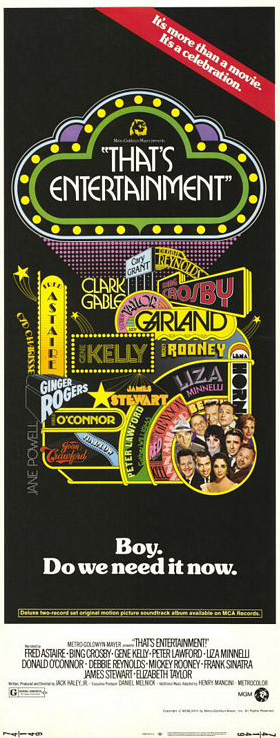
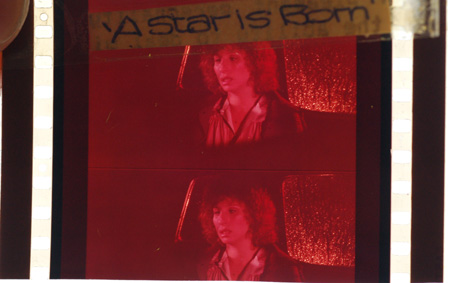 "A Star is Born", one of the first flat spherical 1,85:1 films to be enlarged to 70mm film. Note pillarboxing of image. Two black areas on both sides of image. Editors collection "A Star is Born", one of the first flat spherical 1,85:1 films to be enlarged to 70mm film. Note pillarboxing of image. Two black areas on both sides of image. Editors collectionAlthough the roadshow era essentially ended in 1970, filmmakers and some distributors continued to see a 70mm presentation in certain major American cities, notably New York and Los Angeles, as an enhancement of the prestige of certain films and they could still get higher rentals from a 70mm release in major European cities. But some filmmakers weren’t happy with the image quality of the 2.2:1 width image from spherical photography and when tests proved more satisfying results could be achieved by going with the height of the 35mm 1.85 image and a narrower width, those with the clout began demanding this and by the mid-Eighties, with the increase in 70mm blowups for sound, this became the standard format for blowups from 35mm spherical photography. This led to debates about the first such film to be done this way, with candidates ranging from the 1976 remake of "A Star is Born" to "Days of Heaven" (1978) to a 1979 reissue of the "Exorcist" (1973) to "The Blue Lagoon" (1980). But the forgotten most likely candidates are the documentaries "That’s Entertainment" (1974) and "That’s Entertainment part 2" (1976), which also marked the first time the industry really dealt with the widescreen revolution in such film related documentaries. |
|
 Although most post-1953 documentaries about film history had
been done for television, like Wolper’s famous “Hollywood and the Stars”
series of the Sixties, in which all clips had to be in the 1.33:1 tv format
of the time, there was a series of theatrical documentaries about silent
comics produced by Robert Youngson and released by 20th Century-Fox, though
he was recruited to do one for MGM, "MGM’s Big Parade of Comedy" (1965); in
the early Sixties Harold Lloyd also released two compilations of his silent
comedy shorts. The clips in these films were all duped directly from 35mm
pre-print where it existed and were usually projected at whatever spherical
aspect ratio the theater was using 1), meaning not only were the top and
bottom of the image usually cut off but there were additional cut-offs on
the left side as well as the top and bottom because of the differences
between the old silent 1.33:1 frame and the 1.37:1 sound frame. In some
instances, certain shots would be optically recomposed to get around this
problem. There was also Peter Bogdanovich’s "Directed by John Ford" (1971),
made for the American Film Institute and mastered in 35mm. Because the
ultimate release format was intended to be 16mm for schools, the few clips
used from Ford’s wide screen films, "Mr. Roberts" (1955-CinemaScope),
"The Searchers" (1956-VistaVision), and "Cheyenne Autumn" (1964-Super Panavision),
were taken from tv internegatives. 2) Although most post-1953 documentaries about film history had
been done for television, like Wolper’s famous “Hollywood and the Stars”
series of the Sixties, in which all clips had to be in the 1.33:1 tv format
of the time, there was a series of theatrical documentaries about silent
comics produced by Robert Youngson and released by 20th Century-Fox, though
he was recruited to do one for MGM, "MGM’s Big Parade of Comedy" (1965); in
the early Sixties Harold Lloyd also released two compilations of his silent
comedy shorts. The clips in these films were all duped directly from 35mm
pre-print where it existed and were usually projected at whatever spherical
aspect ratio the theater was using 1), meaning not only were the top and
bottom of the image usually cut off but there were additional cut-offs on
the left side as well as the top and bottom because of the differences
between the old silent 1.33:1 frame and the 1.37:1 sound frame. In some
instances, certain shots would be optically recomposed to get around this
problem. There was also Peter Bogdanovich’s "Directed by John Ford" (1971),
made for the American Film Institute and mastered in 35mm. Because the
ultimate release format was intended to be 16mm for schools, the few clips
used from Ford’s wide screen films, "Mr. Roberts" (1955-CinemaScope),
"The Searchers" (1956-VistaVision), and "Cheyenne Autumn" (1964-Super Panavision),
were taken from tv internegatives. 2)While it’s not clear whether or not "That’s Entertainment" was inspired by the publicity MGM got from its auction of props and costumes in the early Seventies, but about that time editor Bud Friedgen was at work on a documentary on the studio which was taken over by Jack Haley, Jr. 3) Haley was both a film buff and a film collector and knew that presenting the clips in the proper aspect ratio would be of extreme importance to his target audience. Because only a small number of clips from post-1953 films, especially CinemaScope ones, were contemplated, it wouldn’t have been worth the cost to master and release the film in an anamorphic format, so the best approach was the one used: mastering the picture for spherical projection using the American industry standard of 1.85:1 with the clips from pre-1953 films reduced in width in the frame to 1.37:1 (known today as pillarboxing) and the few anamorphic clips reduced in height and spread across the center of the frame or “letterboxed” at 2.35:1. The host segments would be composed for 1.85. (As I recall, the only clips used from spherical films composed for masked projection were "High Society" (1956) in "That’s Entertainment" and "Kiss, me Kate" (1953) in PART 2, both presented at 1.85 in the documentaries.) MGM was long reputed to have never thrown anything away, including outtakes and tests from various films. Since the early Sixties they had been making new, then state-of-the-art pre-print safety elements on everything in its vaults, which was easy and somewhat inexpensive for them since they owned their own lab. I don’t know what practices were used in editing the "That’s Entertainment" documentaries but they ended up with a printing internegative with all the above formats built in. 4) I’ve never handled a 35, 16, or Super 8 print of either film and so don’t know if they were entirely hard matted. Henry Mancini’s incidental scores were recorded in 3 track stereo, which was the standard method at the time and transfers from the stereo dub masters of the CinemaScope films were incorporated into the final dub. I’m assuming that this was a three track dub, to allow for a few 35mm magnetic stereo prints to be made as full 6 track dubs for major 70mm releases had been done decreasingly since the mid-Sixties. 5) It had always been intended to make a small number of 70mm prints on the first documentary and the proper approach would have been to match the height of the 70mm frame to the height chosen for the 1.37:1 clips. The 70mm prints would likely have been blown up directly from the 35mm internegative rather than making a 65mm internegative for the small number of prints desired. Even if it referred to just for the host segments, "That’s Entertainment" was likely the first spherical 35mm film blown up to 70mm to retain the 35mm spherical 1.85:1 aspect ratio. (This article is drawn from information given me 33 years ago by Todd Ramsay, assistant film editor on "That’s Entertainment"; Edward R. Nassour, who worked at MGM Laboratories in the Sixties; and my own knowledge and experiences with laboratory and optical techniques.) |
|
Note 1 | |
|
Since the adoption of the practice of masking off the
spherical frame in 1953, theaters had never been consistent about the
ratio they used, ranging from 1.66:1 to 2:1. By 1956 the American film
industry had accepted 1.85:1 as a standard (it was 1.66 in Europe and
Russia stuck with 1.33) and most theaters built after the Sixties went
with that standard, though there was at least one American chain that as
late as the Nineties was running everything, anamorphic and spherical,
at 2:1, cutting off the sides of the first and more of the height of the
second! |
|
Note 2 | |
|
This was the first such film in which the black-and-white sequences were duped to a black-and-white dupe negative rather than color internegative stock, then intercut with the color negative/internegative footage for release printing on color stock for better image quality than could be obtained by duping to color intermediate stock at the time. Though timing the prints was complicated, this technique would be used on both "That’s Entertainment" films, "The Hindenburg" (1975), and "Funny Business-Comedy From The Movies’ Greatest Era" (1978) a tv clip show I co-edited. It became impractical when Eastman introduced a new print stock with a cyan base dye to minimize fading problems in 1979; it resulted in a black-and-khaki rather than black-and-white image! |
|
Note 3 | |
|
Film historian and editor Aubrey Solomon in e-mail to author |
|
Note 4 | |
|
On "Funny Business" we pre-selected our clips using 16mm tv syndication prints then made full reel reversals off the safety composite fine grains or prints off composite dupe negatives. Once the show was finalized, dupe negative sections were ordered off these pre-print materials and negative cut the standard way, the same technique used on the "That’s Entertainment" documentaries. Sound was transferred off the reversals or prints. On the MGM docs, they made transfers from quarter inch protection tapes which then had to be synced by eye to the picture. Unfortunately, they discovered these tapes had been made without time code so they had to be synced frame-by-frame to the relevant clip before they could be edited! |
|
Note 5 | |
|
20th Century-Fox was the only studio which did the production
recording for its CinemaScope films in three channel stereo, at least
through 1960. All other studios, including those doing films intended
for 6 track 70mm release, panned mono dialog and sound effects tracks
though music was recorded, usually in three channel, though
"Cleopatra"
was done in a very complicated multichannel format. Some stereo
backgrounds were recorded in three and six track stereo. Veteran sound
editor Marvin Walowitz, source of this information, has fond memories of
a six track recording of an actual thunderstorm recorded in Kansas for
"Oklahoma!", portions of which he used in
"The Bible". According to Mr. Walowitz, by the late Sixties most stereo dubs other than those done for
70mm films at Todd-AO were usually three track with a combine of either
the left and center or center and right channels played at 50% volume in
the left-center or right-center channels where desired. "Hawaii" had no
stereo dub at all; for the 70mm prints the mono track was played in all
five front channels. |
|
| Go: back - top - back issues - news index Updated 21-01-24 |