


3 strip shoot in the Melbourne Hills | Read more at in70mm.com The 70mm Newsletter |
| Written by: Bruce McNaughton, DOP, Melbourne. Aranda Film | Date: 12.08.2010 |
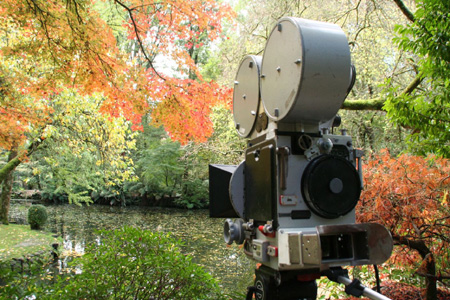 The
Kinopanorama camera photographed by Bruce McNaughton. (c) 2010 John Steven Lasher. Reproduction prohibited. All Rights
Reserved. The
Kinopanorama camera photographed by Bruce McNaughton. (c) 2010 John Steven Lasher. Reproduction prohibited. All Rights
Reserved.Some years ago I built a poor man's Cinerama rig for a motor car launch using three 35MM Arri cameras. The centre one I mounted with an anamorphic lens, the outside two with matching focal length lenses. We projected the images through a giant mock-up of a car using the centre panel as the view through the windscreen and the others as side front window views. Very effective. I wrote a short article about the shoot in a local film magazine and then received a call from John Lasher, then unknown to me, from some 600 miles away. John had just purchased the last working Kinopanorama 3 strip camera from Russia and thought that I may be able to help him get it up to scratch. My first task was to grind all 18 movement pins so that the camera would accept Kodak/Fuji film. All Russian 35MM equipment uses KS perforation film stock and will not run 'Western' film. This achieved I then pulled off the boat anchor of a motor which weighs about 15 kilos and installed our Rotavision 5000 speed crystal motor system. This system has crystal speeds of 1-50 fps in 0.1 increments. The motor and electronics were able to be hidden in the base of the camera so the whole set-up became more physically manageable and a great deal lighter. Still a two (healthy) man lift however with 3000 feet of film aboard... John recently got hold of three 400 ft loads of Fuji 125 ASA stock, courtesy of Fuji Australia so he asked me to shoot a few Autumn scenes for promotional use. As Autumn was approaching I took a drive through the Dandenong Ranges, 40 Km from Melbourne and noted a few locations. It was a 'slow' Autumn as the weather had been mild and the leaves refused to turn until a series of cold nights came along. | More in 70mm reading: My trip to Melbourne Kinopanorama Films Kinopanorama Camera John Lashers' Kinopanorama of 1995 Internet link: The Kinopanorama Experience The Kinopanorama Widescreen Preservation Association |
 3-strip
Kinopanorama sample by Greg Kimble. Angle of view is 120 degrees. (c) 2010
John Steven Lasher. Reproduction prohibited. All Rights Reserved. 3-strip
Kinopanorama sample by Greg Kimble. Angle of view is 120 degrees. (c) 2010
John Steven Lasher. Reproduction prohibited. All Rights Reserved.Click image to see enlargement. Autumn leaves are found on deciduous trees and these are not native to Australia. I found plenty of them but they were growing in front gardens of homes, along village shopping streets or spasmodically in national parks. All fine if you have a standard format camera but Kinopanorama has 3 hungry eyes wanting to show you very wide vistas and I found it difficult to get these without including telegraph poles, fences, roads and other unwanted material. I did manage to find a lovely leafy lake hidden away deep in a national trust property and earmarked this a 'must.' To make up for the lack of wide Autumn vistas and for variety I shot two of the 8 scenes in Australian native locations, one in dark ferns and one in a tall Eucalyptus forest. Before the shoot I ran a few feet through the camera to check the overlap points between panels and the consistency of exposure across the three 35MM matching lenses. This operation with its attendant film wastage due to the very complex threading and unthreading of the camera chewed up a little more than a few feet of film so that when I arrived at the lake to shoot the last and prettiest shot of all I was very conscious that I was indeed short of stock. I still had to shoot a gray card for panel matching purposes so I made this a very swift and short operation running the camera at 10 frames per second to save film. The sun came out between rain squalls and was too bright. The back of the lake was in shade and the exposure required for the backlit Autumn leaves would have rendered this part of the vista very dark. After some time a friendly cloud partially blocked the sun and it seemed that it was going to be fairly consistently 'hazy-bright' for a quick shot. I hit the button and no more that 2 seconds later the film ran out. "Two seconds" I said to myself. "Saved." Enough for a career-saving freeze frame as there was no movement in the scene anyway. BUT after I instructed the lab to take special care of the end of each roll and we pedalled through the material in the telecine suite, to my horror the left panel had not a frame of this lovely scene. There was enough in the other panels to save the situation but without 3 panels there is no show. My precious lake scene was not to be. |
Just to confirm Bruce's reply that only
the 35mm lens kit was used for the shoots. The angle of vision is
roughly 120-degrees across, close to that of Todd-AO. JSL |
| Go: back - top - back issues - news index Updated 21-01-24 |