


"How the West Was
Won" December 7, 2002
|
All
70mm film lists |
| Written by: Rick Mitchell. Introduction by Richard Greenhalgh. | Date: December 2002 |
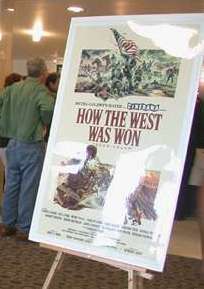 This
morning my wife and I were in attendance for a special advanced showing of
the new Crest Labs print of How The West Was Won at the Cinerama Dome in
Hollywood which was sponsored by our local SMPTE chapter. The new print
looked very good and the sound was excellent - far better than the new
print of This Is Cinerama. Color wise, this print compares very favorably
to John Harvey's Technicolor IB print. When we saw This Is Cinerama I did
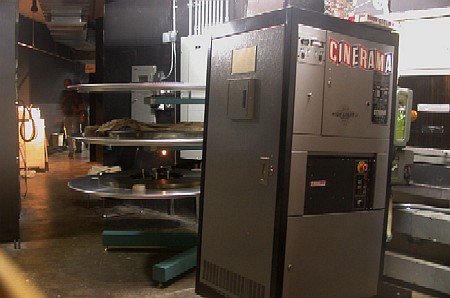
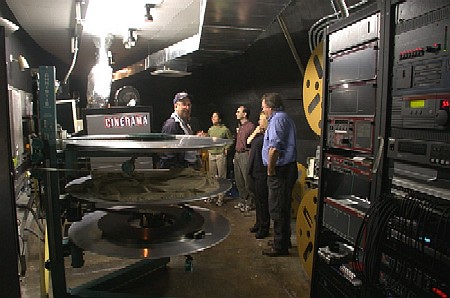
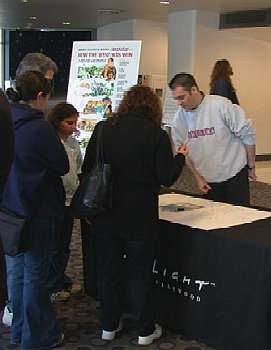
not get any pictures in the booth. I have included some new pictures I
took this morning. This
morning my wife and I were in attendance for a special advanced showing of
the new Crest Labs print of How The West Was Won at the Cinerama Dome in
Hollywood which was sponsored by our local SMPTE chapter. The new print
looked very good and the sound was excellent - far better than the new
print of This Is Cinerama. Color wise, this print compares very favorably
to John Harvey's Technicolor IB print. When we saw This Is Cinerama I did
not get any pictures in the booth. I have included some new pictures I
took this morning.All pictures supplied by Richard Greenhalgh. The following very well written item is from Rick Mitchell who was also in attendance: |
Further
in 70mm reading: "How the West Was Won" in Cinerama Internet link: |
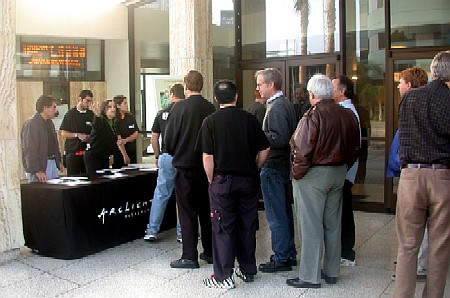 On
the morning of Dec. 7, 2002, nearly 40 years after its London premiere, "How
the West Was Won" had its first "semi" public
presentation in Cinerama at the Cinerama
Dome; it was a private screening for members of the Hollywood Section
of the Society of Motion Picture and Television Engineers. (The Dome
hadn't even been built at the time of the film's LA premiere at the
Hollywood Pacific.) On
the morning of Dec. 7, 2002, nearly 40 years after its London premiere, "How
the West Was Won" had its first "semi" public
presentation in Cinerama at the Cinerama
Dome; it was a private screening for members of the Hollywood Section
of the Society of Motion Picture and Television Engineers. (The Dome
hadn't even been built at the time of the film's LA premiere at the
Hollywood Pacific.)How does "How the West Was Won" look and sound after all these years? Incredible! As all the original Cinerama prints had been made dye transfer by Technicolor and all the subsequent 35mm, 16mm, and video versions from inter negatives, the original had had little use, has been well stored, and the 5251 negative it was shot on has so far proven to have very good dye stability. I thought the print looked as good as a Technicolor IB without being so contrasty (IB freaks will vehemently disagree of course) and the timers and engineers at Crest Laboratories are to be congratulated for their work on all the Cinerama titles, perhaps deserving of a Sci-Tech or honorary Oscar?) |
|
 The
only questionable area was the dupes, the material from "The
Alamo", "Raintree County", "This is
Cinerama", and all the material shot in Ultra Panavision for "How
the West Was Won" (the shots involving rear projection and many
cuts in the action sequences). Here the image does go grainy and a bit
dupey looking, due to the fact that the dupes were made dry gate on the
old 5253 intermediate stock. Most people I talked to who are knowledgeable
enough to be cognizant of these differences said they noticed, but were
not really bothered by them. I was bothered more by the sudden perspective
changes resulting from the use of longer lenses in the 65mm material after
getting so use to the deep focus effect from the three panel cameras' 27mm
lenses; some scenes, such as Debbie Reynolds singing "Home In The
Meadow" on the riverboat just before the intermission are almost
three-dimensional! The
only questionable area was the dupes, the material from "The
Alamo", "Raintree County", "This is
Cinerama", and all the material shot in Ultra Panavision for "How
the West Was Won" (the shots involving rear projection and many
cuts in the action sequences). Here the image does go grainy and a bit
dupey looking, due to the fact that the dupes were made dry gate on the
old 5253 intermediate stock. Most people I talked to who are knowledgeable
enough to be cognizant of these differences said they noticed, but were
not really bothered by them. I was bothered more by the sudden perspective
changes resulting from the use of longer lenses in the 65mm material after
getting so use to the deep focus effect from the three panel cameras' 27mm
lenses; some scenes, such as Debbie Reynolds singing "Home In The
Meadow" on the riverboat just before the intermission are almost
three-dimensional! |
|
 This
brings up another issue raised by the screening of this film, the
contemporary loss of the concept of intentionally shooting for THE BIG
SCREEN. I'm probably one of the few people who've experienced "How
the West Was Won" on film in recent years, via a slightly faded
16mm anamorphic print projected @10 ft. wide in my apartment. Yet I was
seeing things in this presentation that no doubt are on the 16 print but
I'd never really noticed; background action on the sides of the screen,
details of set design and decoration. Overall is the impact of that big
wide image (which I find far more satisfying than Imax), one that actually
doesn't diminish and often enhances intimate moments. There has been an
unfortunate tendency by studio executives and producers in recent years to
see no difference between the theater screen and video, a tendency
reinforced by the trend toward shoebox theaters that hopefully we're
getting away from. The result has been an increasing number of
"epic" films which look better on the tube than even on my 10
ft. screen! (Some of you got my arguments on this point when comparing "Lord
Jim" to the recent "Four Feathers".) The
apparent logistics of dealing with the wide open spaces visible in a film
like "How the West Was Won" might frighten many
contemporary so-called producers to death (we should be so lucky), but
properly worked out, the results are clearly worth it, and not necessarily
prohibitively expensive if directors, production designers, and
cinematographers were allowed and encouraged to use their creative juices.
There is also the aesthetic matter of composing for the big wide screen,
something that hasn't been seriously discussed since the mid-Fifties. This
brings up another issue raised by the screening of this film, the
contemporary loss of the concept of intentionally shooting for THE BIG
SCREEN. I'm probably one of the few people who've experienced "How
the West Was Won" on film in recent years, via a slightly faded
16mm anamorphic print projected @10 ft. wide in my apartment. Yet I was
seeing things in this presentation that no doubt are on the 16 print but
I'd never really noticed; background action on the sides of the screen,
details of set design and decoration. Overall is the impact of that big
wide image (which I find far more satisfying than Imax), one that actually
doesn't diminish and often enhances intimate moments. There has been an
unfortunate tendency by studio executives and producers in recent years to
see no difference between the theater screen and video, a tendency
reinforced by the trend toward shoebox theaters that hopefully we're
getting away from. The result has been an increasing number of
"epic" films which look better on the tube than even on my 10
ft. screen! (Some of you got my arguments on this point when comparing "Lord
Jim" to the recent "Four Feathers".) The
apparent logistics of dealing with the wide open spaces visible in a film
like "How the West Was Won" might frighten many
contemporary so-called producers to death (we should be so lucky), but
properly worked out, the results are clearly worth it, and not necessarily
prohibitively expensive if directors, production designers, and
cinematographers were allowed and encouraged to use their creative juices.
There is also the aesthetic matter of composing for the big wide screen,
something that hasn't been seriously discussed since the mid-Fifties. |
|
 I
was curious as to how the film's plot would work with a contemporary
audience. The majority of those in attendance were fans who'd either seen
it in Cinerama when they were kids or had only seen it on TV, and it still
worked for them. Acting as ushers were younger people from one of the
SMPTE's student chapters; unfortunately I forgot to ask any of them how
they reacted to the film or the Cinerama process. Any responses overheard
by anyone who was there would be appreciated by me and probably by Pacific
Theaters and Warner Bros. I
was curious as to how the film's plot would work with a contemporary
audience. The majority of those in attendance were fans who'd either seen
it in Cinerama when they were kids or had only seen it on TV, and it still
worked for them. Acting as ushers were younger people from one of the
SMPTE's student chapters; unfortunately I forgot to ask any of them how
they reacted to the film or the Cinerama process. Any responses overheard
by anyone who was there would be appreciated by me and probably by Pacific
Theaters and Warner Bros. |
|
 Although
this supposedly has been the industry's best year in terms of income, it's
apparently due more to higher ticket prices than higher attendance. "How
the West Was Won" is going to draw audiences both in Seattle and
here based initially on its reputation, then on word-of-mouth about how
satisfyingly it delivers. One would have to live in a movie theater to
come anywhere close to duplicating the effect of seeing it in Cinerama via
any other film or video format. Fifty years ago Cinerama,
3-D, and CinemaScope attracted large audiences by offering them something
they couldn't get at home. Although
this supposedly has been the industry's best year in terms of income, it's
apparently due more to higher ticket prices than higher attendance. "How
the West Was Won" is going to draw audiences both in Seattle and
here based initially on its reputation, then on word-of-mouth about how
satisfyingly it delivers. One would have to live in a movie theater to
come anywhere close to duplicating the effect of seeing it in Cinerama via
any other film or video format. Fifty years ago Cinerama,
3-D, and CinemaScope attracted large audiences by offering them something
they couldn't get at home."How the West Was Won"'s presentation in LA should make production and exhibition executives realize that making the theater more like the home presentation situation is not going to encourage people to come to the theater, but once again giving them something they can't get at home will, even if it's a 35mm anamorphic film shot as if intended to be seen on a BIG WIDE theater screen. Then there would be hope for 5 perf 70mm, Super Dimension 70, and maybe even a revival of Ultra Panavision! |
|
|
Go: back
- top - back
issues Updated 22-01-25 |
|