


Modernizing the DP70
|
Read more at
in70mm.com |
| Written by: Thomas Hauerslev | Date: 14.08.2019 |
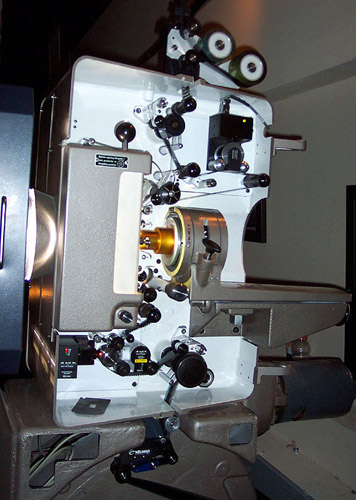 DP70
with internal DTS reader. Image by Mark Gulbrandsen DP70
with internal DTS reader. Image by Mark GulbrandsenFrom the beginning more than 50 years ago, the DP70 has been considered one of the best projectors ever made. Despite that, Philips continued to improve the machine until production ended around 1966. Since then, and especially in the 1990s, the DP70 is still being upgraded, by Kinoton and other private enterprises. This page will show some examples. DP70 RED-LED reverse scanner |
More
in 70mm reading: DP70 / Universal 70-35 / Norelco AAII - The Todd-AO Projector Todd-AO 70mm Projectors Internet link: kinoton.de Philips Museum |
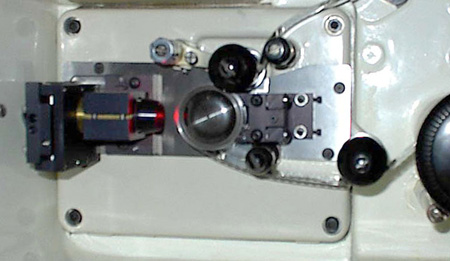 A
reverse scan modification is available from Claco Equipment and Services
(USA). It is based on the original soundhead/ stabilizer and is the only
reverse scan modification that allows use of the no-contact sound drum as
designed by Phillips. It also allows the use of DP70 machines with the Cyan
Dye soundtracks. A
reverse scan modification is available from Claco Equipment and Services
(USA). It is based on the original soundhead/ stabilizer and is the only
reverse scan modification that allows use of the no-contact sound drum as
designed by Phillips. It also allows the use of DP70 machines with the Cyan
Dye soundtracks.The GST LED reverse scan/Jax Light combination allows another full octave of high frequency through to the processor extending hf response to 16kHz with little or no slit loss compensation at all. This upgrade, as well as Kinoton's Dolby Digital upgrade makes it very difficult to tell if you are listening to analog SR or digital in many cases. See DP70 RED-LED reverse scanner |
|
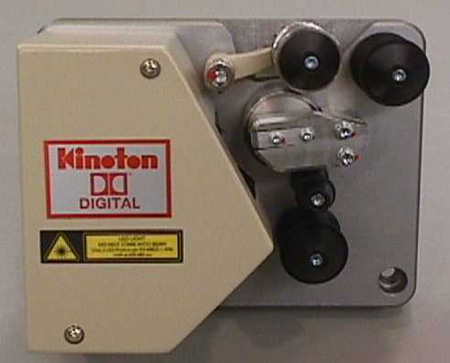 DP70
with reverse scan head. By internal DTS reader. Image by Gerard Bierling DP70
with reverse scan head. By internal DTS reader. Image by Gerard BierlingI did this reverse scan for the DP70 and can tell you that this photo was taken during the first test in Bioscoop Catharijne in Utrecht which was a success and I made another 4. Gerard Bierling's DP70 reverse scanner |
|
870 Special Venue |
|
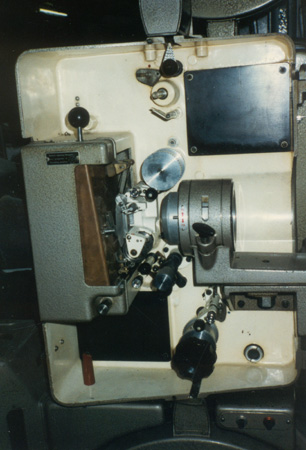 Projector
no. 1754 converted to the 870 format by
Ciné Matériél
in Paris, France. Note missing magnetic cluster and enlarged
sprocket. Picture by Francois CARRIN. Projector
no. 1754 converted to the 870 format by
Ciné Matériél
in Paris, France. Note missing magnetic cluster and enlarged
sprocket. Picture by Francois CARRIN.There are at least two examples of DP70's which have been converted to the 870 format. One 870 DP70 projector was offered at a price of USD 9995.00 dollars from Vistascope Corporation in Atlanta, Georgia, USA and another (SN: 1754) from Ciné Matériél in Paris. |
|
Lens Turrent |
|
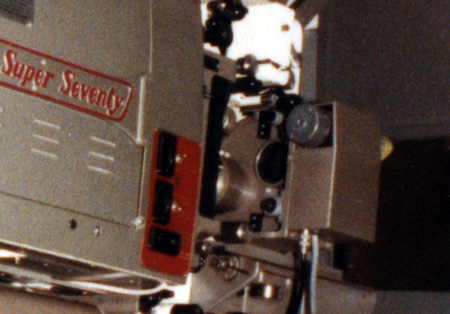 Some
machines in Austria have been equipped with lens turrents Some
machines in Austria have been equipped with lens turrentsDP70s in Austria |
|
The Align-O-Tron |
|
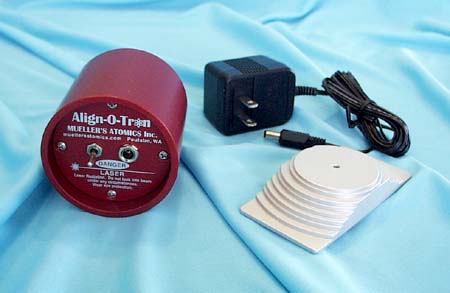 How
to align your lamp house with the Align-O-Tron by
Greg Müller How
to align your lamp house with the Align-O-Tron by
Greg Müller |
|
DP70 special digital reader bracket |
|
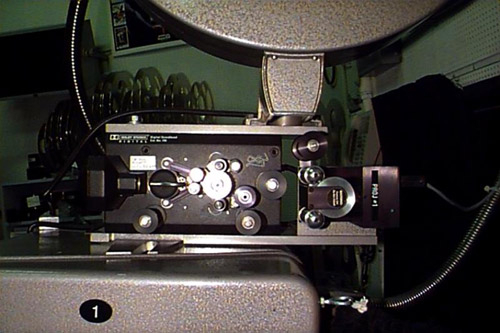 DP70
special reader bracket for mounting digital sound heads. Seen here are the
DTS and Dolby readers. DP70
special reader bracket for mounting digital sound heads. Seen here are the
DTS and Dolby readers. |
|
Cinefocus (no longer available) |
|
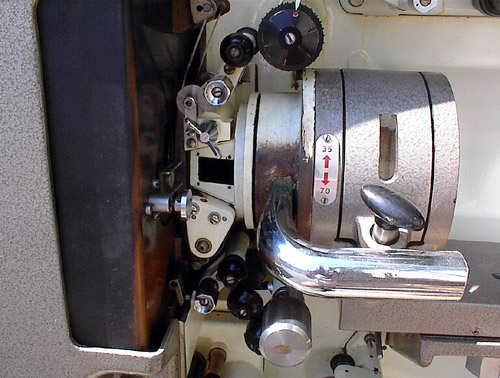 The
Century Cinefocus system applied just slightly positive air pressure to the
film from an outboard blower to keep it from rapidly fluttering when the
heat from large arc lamps would hit the film. The
Century Cinefocus system applied just slightly positive air pressure to the
film from an outboard blower to keep it from rapidly fluttering when the
heat from large arc lamps would hit the film.Obsolete technology. See more |
|
Photo mask by Todd-AO
|
|
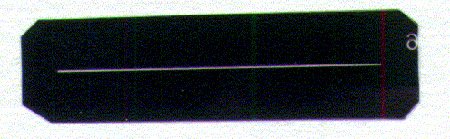 Newly developed photographic slit masks for the DP70 optical sound head
enable the DP70 to faithfully reproduce audio up to 12.5 kHz at 0dB with
little slit loss compensation added in the pre-amplifier stage. This is
equivalent to a half-mil slit or less in a forward scan sound head. Newly developed photographic slit masks for the DP70 optical sound head
enable the DP70 to faithfully reproduce audio up to 12.5 kHz at 0dB with
little slit loss compensation added in the pre-amplifier stage. This is
equivalent to a half-mil slit or less in a forward scan sound head. The original brass slits were expensive to manufacture; it was difficult to obtain clean and straight edges on the sides of the slit, so they were limited in their high-frequency output. Not only do the new photo slits capture the high-end frequencies of modern stereo optical sound tracks, they are inexpensive and easy to install. Photo mask by Todd-AO to boost the high end output to 0dB at 12.5K and -1dB at 16K. |
|
A new film gate for the DP70 projector |
|
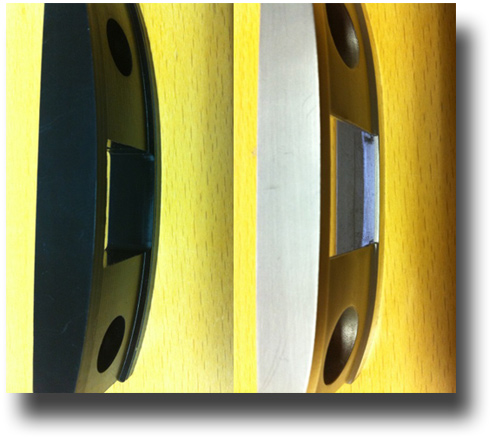 Rosbeek
Techniek in Holland have made a new 35mm film gate for
the DP70. This will also be available for 70mm. It is
made of black Delrin. The old one is a little flat at the gate because the
film should run as flat as possible through the gate. The lenses back than
were not so good as the lenses these days to perform under a little
difficult situation what the flat part of the film gate is because the film
can hardly run flat over a most bended film gate. Rosbeek
Techniek in Holland have made a new 35mm film gate for
the DP70. This will also be available for 70mm. It is
made of black Delrin. The old one is a little flat at the gate because the
film should run as flat as possible through the gate. The lenses back than
were not so good as the lenses these days to perform under a little
difficult situation what the flat part of the film gate is because the film
can hardly run flat over a most bended film gate.A new film gate for the DP70 projector |
|
|
Go: back
- top - news index Updated 21-01-24 |