Visit biografmuseet.dk about Danish cinemas (in Danish)
You are in the Show with Todd-AO • "TODD-AO 70mm film, plus the TODD-AO special camera, plus the TODD-AO newly developed 6 channel high fidelity magnetic sound, plus the TODD-AO "all purpose" 70mm projector and the great arched TODD-AO screen equal the most revolutionary of all screen inventions, with clarity of perspective, detail and color reproduction never before achieved.
TODD-AO PROCESS HISTORY
The Todd-AO Process By The Todd-AO Corporation The ultimate result of intensive research by a team of research and engineering scientists headed by Dr. Brian O'Brian: "a process of motion picture photography and projection that establishes the illusion of participation in the action"
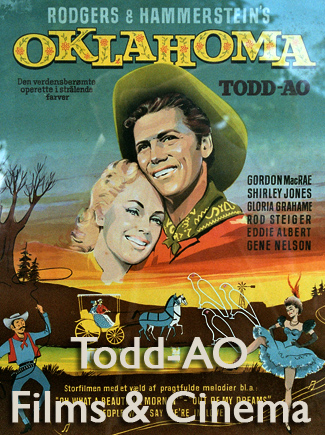
"Oklahoma!" - The First Movie Produced by Todd-AO By Gordon Macrae On Sunday night I will act as the host of one of the most important telecasts of my career. At that time, I will tell the story of how "Oklahoma!" was made. I will be helped in my storytelling with most of the principals from "Oklahoma!", including the wonderful team of Rodgers and Hammerstein.
Todd-AO Process Shown At MGM Studio By The Reflector This screening, followed by a second showing in the evening to people prominent in the Hollywood motion picture industry, resulted in "rave" notices in Hollywood and Los Angeles papers, as well as feature stories in the New York Times and Variety
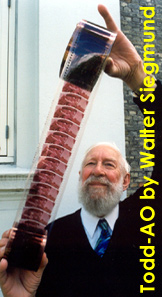
Walter Siegmund Remembered By Thomas Hauerslev It is with great sadness I must report the passing of Walter Siegmund, one of the pioneers and engineers of the Todd-AO process. Walt was extremely kind and helpful, and always referred the "days of Todd-AO" to be among the happiest days of the working life.
The Drake, Plymouth, England By Kinematograph Weekly The aim in designing The Drake was to match up to the conception of the showman's ideal form of presentation. We aimed at nothing less than perfection in public entertainment.
Todd-AO Birth date By Brian O'Brien On October 15th, 1952 I received a phone call from a Michael Todd in New York City, who wished to come to see me at Rochester that evening. I had never heard of Todd, but it seems that he is a well-known Broadway producer.
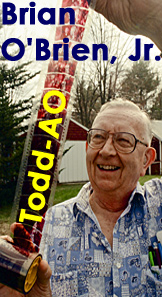
How Todd-AO Began By Brian O'Brien, Jr. My father was a college professor, uninterested in show business, and had never heard of Mike Todd, so when Mike called him late one night saying he wanted a meeting, my dad was naturally cautious.
Distortion Correcting Printing Process By Grant Lobban The process was originally designed to eliminate keystone distortion, distortion resulting from using a deeply curved screen, plus correcting the distortion arising from use of the extremely wide-angle lenses
Todd-AO The Show of Shows By John Belton "Oklahoma!" was a hot ticket; even Cecil B. DeMille had trouble getting seats during the first few weeks of its run. Todd-AO was about showman-ship. It provided high quality subject matter, lavish production values, big screen entertainment, and six-track stereo magnetic sound.
The Amazing Optical Adventures of Todd-AO By Jeff Hecht Todd had just launched Cinerama, a wide-screen system that put the audience in the middle of the action. Yet he knew the cumbersome three-projector Cinerama system dated from before World War II, and had split with his partners even before the first Cinerama film opened.
Hollywood Comes to American Optical Co. Roy C. Gunter Jr. O'Brien was interested in what Todd said about Cinerama and sent Siegmund to New York to look at the system. He reported back to O'Brien that while the optical system was not really sophisticated, the audience response to the wide screen was clearly favorable.
Historical Wide Screen Gathering By Thomas Hauerslev Around the table were key personnel from three major large format systems from the history of movies; Cinerama, Todd-AO and IMAX. None of these gentlemen had ever met before.
Todd-AO 65mm Test By Thomas Hauerslev Wednesday 9 February 1994, review of a very interesting reel of 65mm film which had been discovered at the Nederlands Filmmuseum in Amsterdam.
The Miracle of Todd-AO Final review May 1, 1956 Todd-AO's intense feeling of realism and its possibilities for intimacy and emotional participation convinced Richard Rodgers and Oscar Hammerstein that this was the medium in which to present on the screen their American classic, "Oklahoma!"
Full credits for "The March of Todd-AO" Louis de Rochemont Associates has produced for Magna Theatres a colorful and absorbing 1500 foot film to be shown as a prologue to the roadshow engagements of "South Pacific".
"Man in the 5th Dimension" By Thomas Hauerslev One of the most unique and rarely seen Todd-AO films ever produced, was a 28 minute film filmed in 1963 to be shown exclusively at the Billy Graham Pavilion at the 1964-65 Worlds Fair in New York
WHAT IS TODD-AO?
What is Todd-AO? The Todd-AO Corporation press release 1B "TODD-AO 70mm film, plus the TODD-AO special camera, plus the TODD-AO newly developed 6 channel high fidelity magnetic sound, plus the TODD-AO "all purpose" 70mm projector and the great arched TODD-AO screen equal the most revolutionary of all screen inventions, with clarity of perspective, detail and color reproduction never before achieved.
As a result, with TODD-AO, audience participation now has its fullest and truest expression. Todd-AO is the dream of Michael Todd, plus the technical skills of the American Optical Company whose research staff headed by Dr. Brian O'Brien, jointly succeeded in developing "a motion picture system that would photograph action in a very wide angle....with one camera....on one strip of film....to be projected from a single projector....on a very wide screen....with a quality so perfect that the audience would be part of the action, not just passive spectators."
Dr. Brian O'Brien 1953:
"....with Todd-AO (70mm), audience participation now has its fullest and truest expression".
Working for Mike Todd By Glenda Jensen Midori Tsuji was a fascinating and beautiful woman. She took care of everything for Mike and, occasionally, for Elizabeth. I wanted to be like her.
Working for Todd-AO By Dan Leimeter I became Chief Projectionist at TAO in 1981, and a few years later the Naify family sold their immense holdings in the United Artists Theatre Circuit, and redirected the cash into modernizing and expanding Todd-AO.
Robert Hopkins, Inventor of Todd-AO Lens dies By Sharon Dickman Robert Hopkins died July 4, he was 94. His lens designs included the Todd-AO lens used to produce high definition, wide aspect-ratio films shot on large format film
Walter P. Siegmund, a small bio I was born in Bremen, Germany in 1925. We left for New York and arrived on September 13, 1930 and left immediately for Rochester, New York.
Walter Siegmund about Todd-AO By Thomas Hauerslev About the early days of Todd-AO when he met Dr. Brian O´Brien and Mike Todd 15 October 1952.
Garrett Brown meets Walter Siegmund By Garrett Brown Dr. Siegmund was a tall, gray-bearded, Nordic-looking fellow with a gentle professorial manner. He was completely film-savvy, in fact had developed Todd-AO.
Howard Terpning and Joseph L. Mankiewicz's “Cleopatra“ By Gerhard Witte A look at the different “Cleopatra” posters and the controversy surrounding the making of the famous poster art. Howard Terpning is a painter and illustrator of our time. He is the most renowned and honored Western artist painting today.
The First Todd-AO Theatre in Scandinavia By Thomas Hauerslev 3 Falke Bio is regarded by projectionists and devoteés of 70mm film as the best Danish cinema there ever was. It is sadly missed and vividly remembered as the cinema to watch 70mm and 6 Track Stereophonic Sound.
The Rivoli Theatre By John Belton In preparation for the premiere of “Oklahoma!”, the Rivoli underwent an extensive, $350,000 renovation, including the installation of a new booth and new 1600 seats
Cinerama and Todd-AO at the Syossett by Joe Kelley The screen frame had an adjustable curvature to accommodate the Todd AO specified deep chord depth while permitting 35mm Flat and Scope wide screen formats to form lesser chord depths.
Todd-AO at the Savoy By Udo Heimansberg There were not too many 70mm screenings at the Savoy, because Düsseldorf already had six Todd-AO and one Cinerama theatre
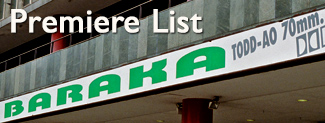
"BARAKA" IN TODD-AO, AT DGI Byen, 10. AUGUST 2000
Todd-AO at "Sea" By Thomas Hauerslev Ron Fricke was very pleased to know "Baraka" was shown in a Copenhagen swim bath. It was one of his original ideas to have it shown outside regular cinemas
TODD-AO IN THE LIGHT OF HISTORY
In the Splendour of 70mm By Grant Lobban While working on "This Is Cinerama" Michael Todd became convinced that there must be an easier way of achieving the same "wrap around" effect using only one projector and a single strip of film.
Grant's Blow-up Blog By Grant Lobban A blow-up is the term used to describe a print made by enlarging, or “blowing-up”, smaller formats, usually those on 35mm film, but 70mm prints have also been derived from 16mm and even 8mm originals.
MIKE TODD, JR & "SCENT OF MYSTERY"
Mike Todd, Jr. Interview By Roy Frumkes “This Is Cinerama” opened to rave reviews. All of Dad's ideas had worked - the name of the film was his, the roadshow concept was his. No one had believed his predictions about Cinerama; now everyone was listening.
Mike Todd, Jr. Obituary Michael Todd Jr., who made a Smell-O-Vision film that combined movies with changing odors, died May 4, 2002 at his home in Ireland. He was 72.
Some thoughts after a 2004 screening By Rick Mitchell A very young Denholm Elliott, does very well in a role that appears to have been conceived for a David Niven, but Peter Lorre seems to be sleepwalking through his part and Paul Lukas and Leo McKern weren't exactly household names in those days.
The Lingering Reek of “Smell-O-Vision” By Patrick Kiger & Martin Smith While "Scent of Mystery" wasn’t the first attempt to employ aromas in filmmaking, it was by far the most technologically intricate. It was the first motion picture that relied upon smells as integral devices in the plot
Cinestage 34mm in London When "Around the World in 80 Days" originally opened in London, England in 1957, it was not in 70mm Todd-AO, but in the 35mm Cinestage format. The Cinestage format was a reduction from the 65mm 24 fps. negative with 6-track sound coming from a separate 35mm dubber.