


The California Theatre: San Jose's 70mm Secret |
Read more
at in70mm.com The 70mm Newsletter |
| Written by: Robert Smith | Date: 10.08.2009 |
 Image
by Robert Smith Image
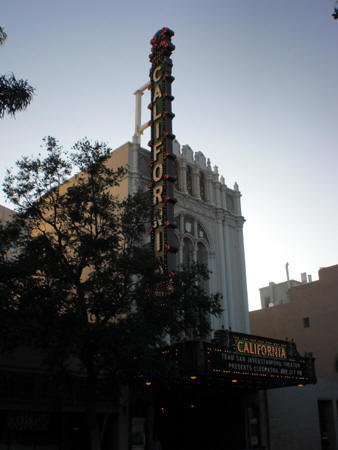
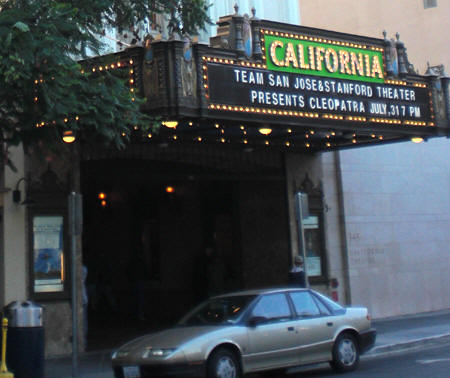
by Robert SmithThere are few theatres left in the world that display 70mm film with some regularity. One of the best, and best preserved, must surely be San Jose's California Theatre. It is also a bit unknown. Located between 1st and Market near modern San Jose's attractions (the Tech Museum is a short walk), the California Theatre is one of the finest extant 70mm houses in the world. Built in 1927 as part of the Fox chain that included the San Francisco Fox and also the Village in Westwood, the California (aka Fox during part of its life) has always been considered the finest theatre in San Jose. Its transition through the years ended with its closing in the early 70's, with the expectation that it would suffer the customary fate of truly beautiful theatres from the cinema's golden age. Fortunately, a new life developed for the California Theatre in 2004, largely as a by-product of Silicon Valley's success. The San Jose Redevelopment Agency partnered with the Packard Humanities Institute to fund a major restoration of the original theatre. See www.shomler.com for more photos and details. The restoration and enhancement of this theatre is magnificent. The backstage was greatly enlarged with modern facilities for live presentations. The retail space near the front was converted to a part of the theatre. For most of the year, the theatre is home to the San Jose Opera and other live performances. |
More
in 70mm reading: Internet link: shomler.com arcadiapublishing.com |
 Image
by Robert Smith Image
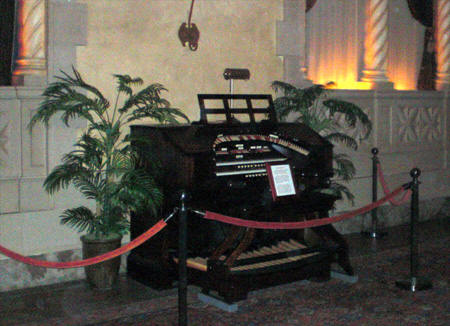
by Robert SmithThe California has also been equipped with two restored theatre organs and also Norelco DP70 projectors. For the last several years, during January and also during the summer, a short 70mm program has appeared. This summer, the 70mm films are "The Sound of Music", "Playtime", "Cleopatra", "West Side Story", and the obligatum of every 70mm festival, "Lawrence of Arabia". This report focuses on the 7/31-8/1 presentation of "Cleopatra". I first saw "Cleopatra" in 70mm in its roadshow release in 1963. The film had been released at 4 hours 3 minutes but was cut about 20 minutes almost immediately, so I originally saw the slightly cut version. Later 35mm releases cut the film even more. While I have seen the film many times since in 35mm and on video, this is the first re-viewing for me in 70mm, using the new print that Fox created a few years ago. As a film, "Cleopatra" is arguably the most "spectacular" film ever made, with sets, costumes, cinematography, and music to rival or exceed the other 70mm event films. It is also an excellent drama with superb acting and pitch-perfect dialogue written by director Joseph L. Mankiewicz, exploring themes of ambition, obsession, betrayal, and dissipation as well as passion and aspiration. |
|
 Image
by Robert Smith Image
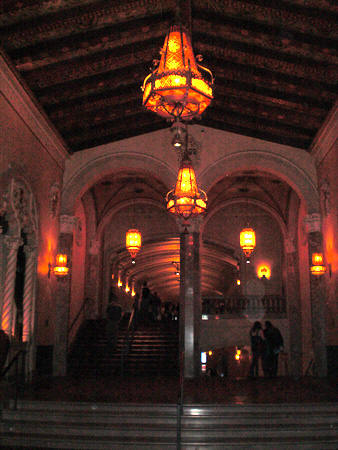
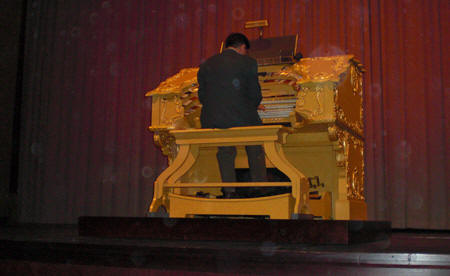
by Robert SmithA major subtext of the film is the passage of time and humans' inability to control time or mitigate its effects. This is laid out in the plot itself, the sharp yet melancholy dialogue, and the beautiful fresco-like paintings first displayed in the main title. These paintings morph from a decayed state to a vivid recreation of events long ago. We feel that we can almost touch and even smell the very distant past. How ironic, yet serendipitous, it is to see this film in a beautifully restored print in a theatre that is itself beautifully restored. How sad to realize that most of the cast and crew of this masterpiece are now gone, even as they appear to be in their prime on the screen. "Cleopatra" is now as much a part of history as the events that it portrays. Thanks to film, especially 70mm, we can still see it, not as a faded fresco, but in its original magnificence. There is much to say about the theatre itself. The lobby almost looks like a set for "Cleopatra"! The theatre has not one but two Wurlitzer theatre organs, both owned by the Packard Institute. One is in the lobby, and the other more traditionally located in the auditorium. The acoustic isolation of the auditorium is so great that I would guess both organs can be played at once without any sonic conflict. The auditorium organ was played before the overture and then during the intermission before the entr'acte. This is very unusual for a roadshow and I cannot remember an instance during the 50's or 60's where a theatre organ was played during a 70mm presentation, with the exception of "Scrooge" at Radio City Music Hall in 1970 (which had a floor show.) The admission price was a grand total of $5.00, which included free popcorn. This is not that much more than the original roadshow price for "Cleopatra", forgetting a factor of 5 or 6 inflation! The auditorium was over half full on a Saturday night, and the crowd was very appreciative of the film. |
|
 Image
by Robert Smith Image
by Robert Smith(Before discussing the presentation, I should warn you that I am very particular, so please take this into account.) The film was reasonably well exhibited, with some problems. The soundtrack is now DTS, which sounded fine, but I still prefer 6 track magnetic. I believe that the front stereo sound stage is now only 3 channels instead of the original 5, which still thankfully had the original directional dialogue. The center channel seemed trimmed a bit low to my taste, making panning to the sides actually increase the volume of a sound. I was sitting in the 3rd row, and could not hear any surround activity; this could of course be an artifact of the size of the auditorium. The picture had some problems. The aspect ratio was about 1.9, but should be 2.2, so some image was lost from the sides. The aperture plates were not right, giving a gray imminence to the edges of the image. The top masking had some issues on both sides, which may be the curtain. These should all be fixable issues (unless different focal length lenses cannot be secured.) This does raise some issues about the contemporary exhibition of classic 70mm films. During the golden age, a roadshow print would arrive at the theatre some days before the engagement was to begin. This would allow the staff the opportunity to note the cues, time the curtain, and adjust all aspects of the projection. I can remember having two dry-runs before opening just to make sure everything was perfect. |
|
 Image
by Robert Smith Image
by Robert SmithToday, of course, a 70mm film may be exhibited once or twice as a part of a series or festival, meaning that there is no opportunity to get it right. For example, the 2008 showing of "How the West Was Won" at the Cinerama Dome suffered from this problem in that the sound was woefully incorrect, but with only one showing, there was no chance to fix it. Another problem for 70mm is that the proper theatres no longer exist. As magnificent as the California Theatre was and is, it is not the perfect visual or aural configuration for 70mm. Theatres like San Francisco's North Point, Hollywood's Cinerama Dome, the Cooper in Omaha or the Capri in Des Moines were optimized for 70mm exhibition. Most of these houses have long since been destroyed. So, we are often left with the "compromise" of a theatre like the Egyptian in Hollywood or the Castro in San Francisco as our only remaining venues for 70mm exhibition. I should be remiss not to note that Gary Lee Parks, author of Theatres of San Jose, and Jack Tillmany, author of Theatres of San Francisco, were both in attendance. We had a good conversation with them about the presentation and theatres in general. (See www.arcadiapublishing.com for details about their books.) One of the joys of 70mm presentations is the people you meet and talk to. I hope that you are able to make a trip to San Jose to see 70mm at the California sometime. Help make this theatre better known. While you are in the Bay Area, please check out the Stanford Theatre in Palo Alto. Also run by David Packard, it is the finest repertory theatre in the world for main-stream Hollywood classics of the 30's through 50's. And don't forget our beautiful Castro Theatre in San Francisco, which has a vibrant and eclectic program of old and new films shown in what is now San Francisco's best house. |
|
About the author |
|
|
Robert Smith is a vice president of
engineering at a research firm in Palo Alto, and also works at Stanford
University. During his college career, he was a union projectionist in Des
Moines, IA, projecting 35mm and 70mm films. He is particularly interested in
roadshow and "event" films and standards of excellence in theatre operation
and film exhibition. His major claim to fame is that he saw "Doctor
Zhivago" 175 times and still likes it! |
|
|
Go: back
- top - back issues
- news index Updated 21-01-24 |
|