


Draken - A Brief Technical
History | Read more at in70mm.com The 70mm Newsletter |
| Written by: Uncle Stefan Adler and Magnus Elm. Reprinted from Swedish Widescreen Centre with permission | Date: 01.01.2012 |
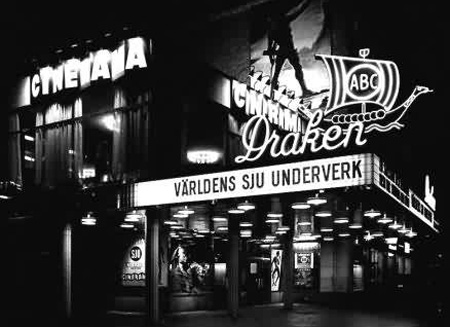 The
first Cinerama film at the Draken. "Seven Wonders of the World". Image from
Swedish Widescreen Museum's page, used with permission from Uncle Adler. The
first Cinerama film at the Draken. "Seven Wonders of the World". Image from
Swedish Widescreen Museum's page, used with permission from Uncle Adler.Opening the 26th of April in 1956, Draken is the last (?) of the BIG theaters ever built in Gothenburg. No cinema was built after Draken for another 18 years. (Then came a multiplex in a mall!) By the time of Draken's opening, CinemaScope, Cinerama and Television, had overthrown classic cinema design and made screens wider and with stereophonic sound. The original CinemaScope screen was 12,6 meter, which was considered a giant screen back then. | More in 70mm reading: Vinterpalatset A Story of Magnificence, Proud and Mourned 70mm Cinema Profile The Royal, Malmö So, what about the Sound of Music on Blu-Ray? I’m as normal as a Blu-Ray Pie… "Where Eagles Dare" - 40th Anniversary 1969 - 2009 |
 Author
of this article, Mr. Stefan Adler, editor of the Swedish Widescreen Pages.
Image by Thomas Hauerslev Author
of this article, Mr. Stefan Adler, editor of the Swedish Widescreen Pages.
Image by Thomas HauerslevOnly after three years in running, the Cinerama and the 70mm Todd-AO had a breakthrough in Sweden. The Victoria was equipped for 70mm and Draken for Cinerama. Draken was the only true Cinerama-theater in Sweden, while Stockholm and Malmoe, each carried one Cinemiracle-installation later modified for Cinerama. Draken opened its Cinerama with "The Seven Wonders of the World" December 14, 1960. A complete list of Cinerama screenings at Draken. In 1966, Draken was equipped for 70mm projection, with two Zeiss Favorit 70 projectors, still in use today. (screen size approx. 7x15 m) The first 70mm presentation was the Metro Goldwyn Mayer production of "Operation Crossbow", followed by a string of major 70mm blockbusters, of which "Doctor Zhivago" showed for more than one year. A complete list of 70mm screenings at Draken. | |
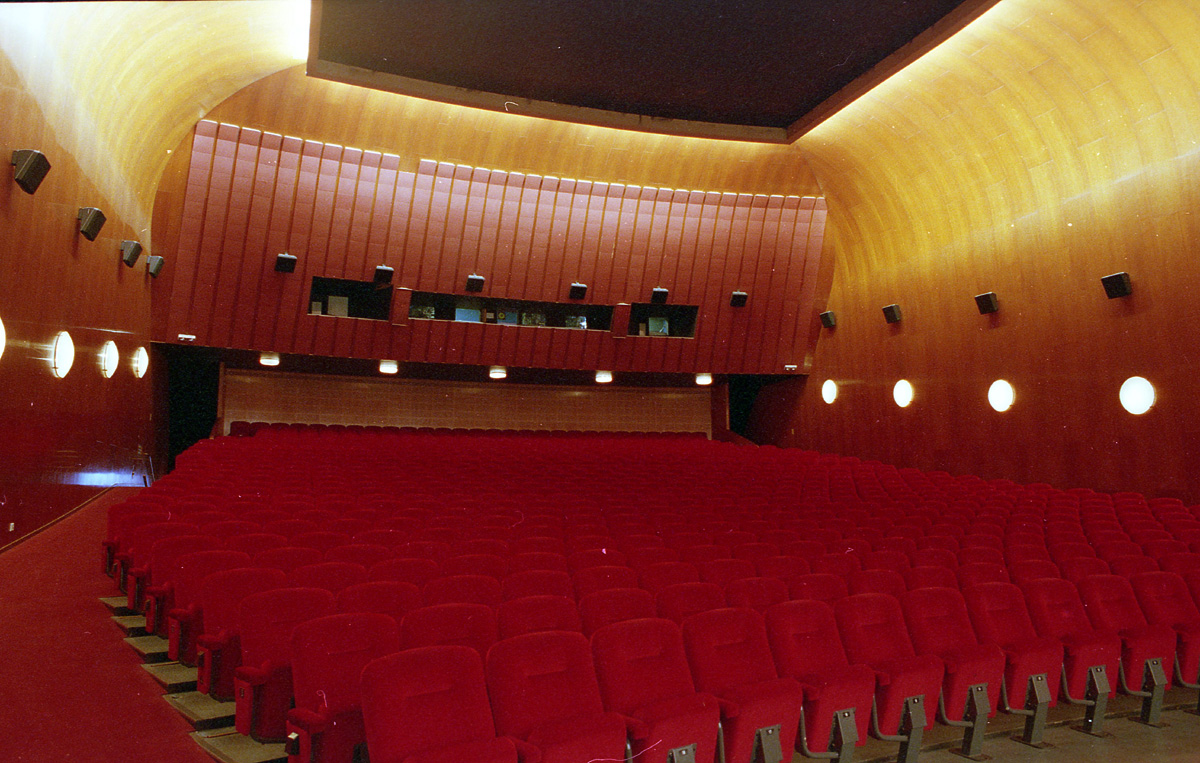 The
Draken. View towards the projection room. Image by Thomas Hauerslev The
Draken. View towards the projection room. Image by Thomas HauerslevClick on the image to a see a large version The Cinerama sound equipment was modified for 70mm 6-channel stereophonic sound and was in use until the event of Dolby Stereo in the late 70´s. The original 2,5 kW Zeiss Xenosol III xenon lamps, running at approx. 85 amps, wasn't quite sufficient for the screen size, especially since the number of 70mm releases decreased and we started boosting the 35mm anamorphic to the same screen width. In 1976 we changed the 2,5 kW's to new 4 kW Cinemeccanica Zenith 4000, running at approx. 130 amps. Now the big screen flooded with light, just as good as in the carbon-arc days. It was not only film width declining during the 70´s. The sound was diminished to a similar degree, with different ways of encoding stereophonic sound to the optical soundtrack. | |
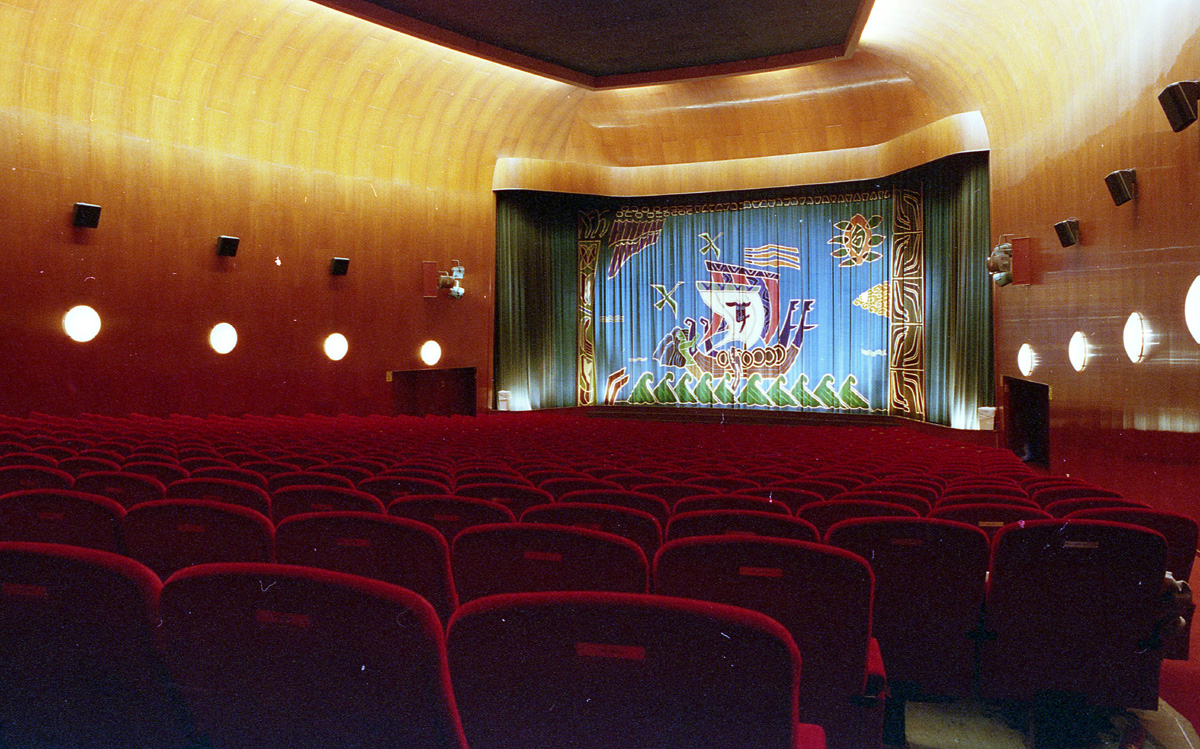 The
Draken's beautiful blue curtain with a wiking ship. Image by Thomas Hauerslev The
Draken's beautiful blue curtain with a wiking ship. Image by Thomas HauerslevClick on the image to a see a large version Before the breakthrough of Dolby Stereo, we had a brief encounter with a Hungarian no-name two channel sound system, with absolutely no noise reduction, nicknamed "Goulash-stereo"! The button on the control panel is still there and it's working. This was back in 1978. In October 1979 Draken was equipped with Dolby Stereo and also new power amplifiers and new speakers in the auditorium. The first Dolby film was Riddley Scott's “Alien” - unfortunately only presented in 35mm Panavision. | |
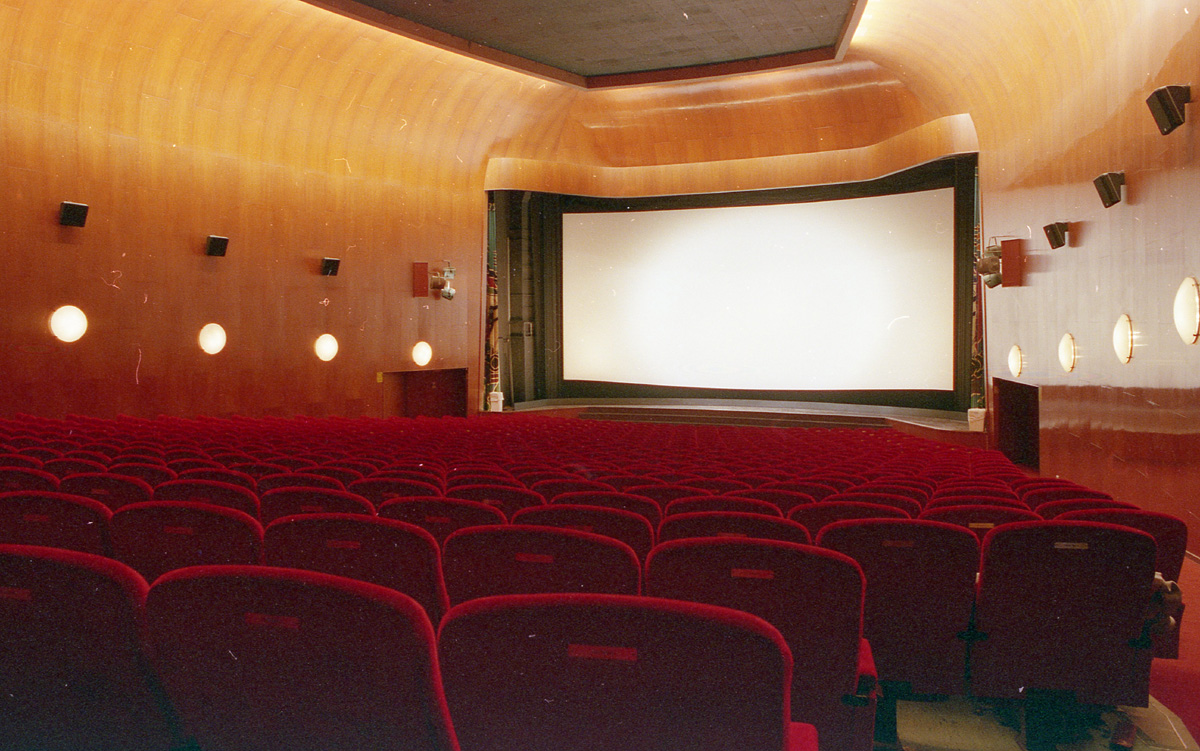 The
Draken's curved 70mm screen. Image by Thomas Hauerslev The
Draken's curved 70mm screen. Image by Thomas HauerslevClick on the image to a see a large version By the time of the second Star Wars movie - “The Empire Strikes Back” - in 1980, the sound equipment was further improved. Special sub-bass speakers were installed, some years before Dolby discovered the need for it (!) and separated the lowest bass sound through its own amplifier system. To avoid power losses and distortion, all speaker cables were replaced with more stout ones. A wall surrounding the speakers was built behind the screen and dampened with an old cinema curtain for total acoustic perfection. The result was tremendous and manifested the cult status of the theater's sound system. | |
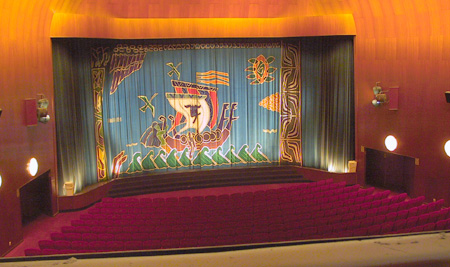 Draken's
beautiful wooden panels and the wiking curtain seen from the projection
room. Image by Thomas Hauerslev Draken's
beautiful wooden panels and the wiking curtain seen from the projection
room. Image by Thomas HauerslevThe man, responsible for customizing and construction of the sound system, was Stefan Sjöman of Cinema Electronics. A Gothenburg based service company to the cinema industry no longer in operation. The same company, Cinema Electronics, was involved in the customization of the 70mm sound equipment, two years later in 1982, when the Steven Spielberg production "Poltergeist" opened in 70mm Dolby Stereo. In 1988, Draken was promoted "Principal Theater" by Gothenburg Film Festival. Due to the festival´s special demands, a 16mm high quality Bauer Selecton dual band studio projector was installed, making it possible for Draken to host every format and event. | |
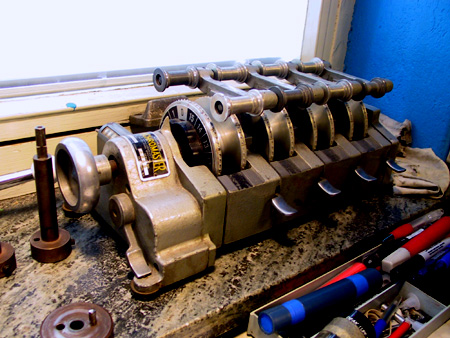 Signs
from former times of grandeur. Neumade's Synchromaster for 4-strip Cinerama
(3x image & 1x sound). Image by Thomas Hauerslev Signs
from former times of grandeur. Neumade's Synchromaster for 4-strip Cinerama
(3x image & 1x sound). Image by Thomas HauerslevIn 1990, Draken got Dolby SR/Spectral recording, first movie shown was "The Hunt for Red October" 713 brand new seats were installed in the auditorium during summer 1991. 1992, due to Festival needs, the 16mm projector was converted for super-16, a low-budget format primarily used for blowup to 35mm 1,66:1, rarely screened in 16mm | |
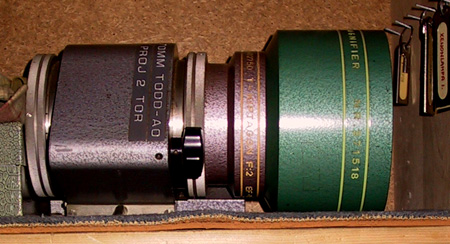 Philips
/ ISCO T-Kiptagon projection lens, with a magnifier, for 70mm projection. Image by Thomas Hauerslev Philips
/ ISCO T-Kiptagon projection lens, with a magnifier, for 70mm projection. Image by Thomas HauerslevIn the opening speech of the 1995 Festival, it was announced that Draken, owned and operated by Svensk Filmindustri /SF, was to be closed down the coming summer to the benefit of the expanding multiplexes. SF was willing to leave the cinema to the Gothenburg Film Festival. SF's main concern was the seats, newly installed, which could easily be moved to another cinema. An appeal was directed to the audience, to raise enough money to buy the seats and save the theater. This turned out very successful and each one of the 713 seats were sold symbolically for SEK 1.000! World famous Swedish director, Ingmar Bergman, was among those buying a seat and rescuing Draken | |
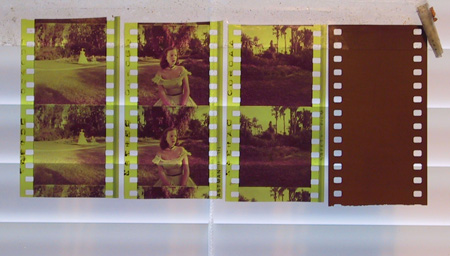 Signs
from former times of grandeur. Faded "This is Cinerama" 3-strip clip in
Draken's window. Image by Thomas Hauerslev Signs
from former times of grandeur. Faded "This is Cinerama" 3-strip clip in
Draken's window. Image by Thomas HauerslevBetween 1995 and 1999, Draken was a Festival theater. and did also serve as a screening facility for the Swedish Film Institute, with special events and directed performances to schools, special previews and openings. Due to the high costs of running such a large and demanding theater. Without any true commercial screenings, the original owners, the Swedish Labour Movement - took over the operations in July 1999, with the aim of running conferences and convents at Draken on a commercial basis. The possibility of making a commercial success of Draken without blockbuster movies is to my view somewhat vain. Hopefully someone will come up with an alternate plan. What about a joint venture with American film distributors? | |
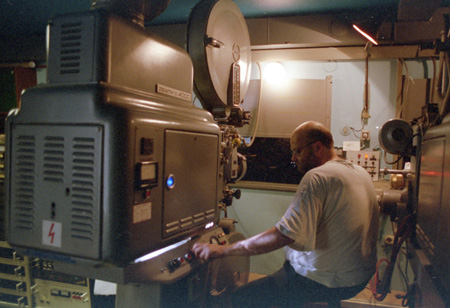
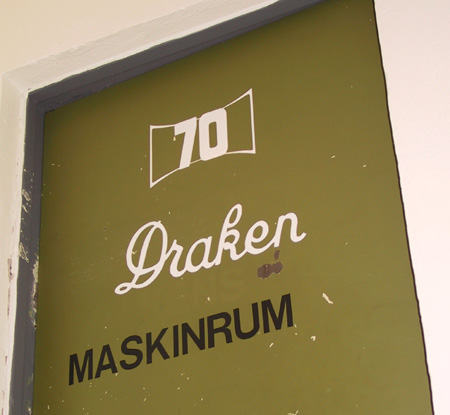 The
Draken's projection room entrance. A mans world of heavy duty 70mm and Cinerama.
Image by Thomas Hauerslev The
Draken's projection room entrance. A mans world of heavy duty 70mm and Cinerama.
Image by Thomas HauerslevAs time goes by and we have entered the new millennium, it pretty much seems like Draken will remain. Except for an occasional screening and the weekly movie studio activity there are not many shows run, though. Once a year the Gothenburg Film Festival still revive Draken when it hosts all the main events during a couple of busy days. (Unfortunately a main event for an old 70mm projectionist and a main event for a "Dogma-cineast" are quite apart...) The more odd and noteworthy is, that the "new" owners actually have invested in new state of the art equipment and digital sound - and actually has kept and renewed the ability to show 70mm, even if it is only 3 channels behind stage these days. Honor to them for doing such a wise thing! I surely hope that there will be some commercial screenings as well in the future - even if the odds for new 70mm prints seems worse than ever. What about a joint venture? The new equipment was recently installed by Winberg Kino and my old colleague Ulf Jansson - which from now on puts him in the "Draken Hall of Fame" and Draken back in the lead of theater sound in Gothenburg when joining the digital era. | |
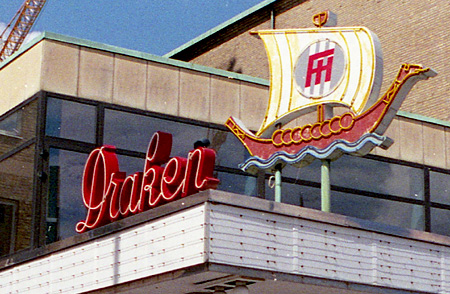 The
entrance of the Draken - "The Dragon", the name of the ship. Image by Thomas Hauerslev The
entrance of the Draken - "The Dragon", the name of the ship. Image by Thomas HauerslevThe heart of the gear is a DOLBY CP500 with active split in the processor (CAT683) and two CAT701 Digital Readers placed right on top of the analog magnetic sound units on the 70mm projectors. 70mm/35mm magnetic sound goes through a Dolby MPU unit with CAT91C preamplifiers. Heavy listening power is carried out by five LAB1000 power amplifiers for Left, Center, Right and two sub-bass channels. Surround speakers are driven by four EA power amplifiers, two for each side of the stereophonic surround. All this play through three JBL 4675C-8LF stage speakers and four JBL 4645C sub-basses. The surround plays through sixteen JBL 8340A, mounted on the auditorium sides. | |
Post Scriptum August 2002 | |
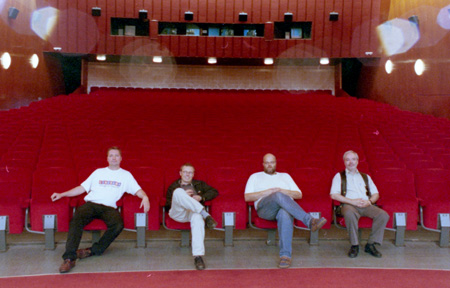 Friends
of the Draken on the front row in 2003, Thomas Hauerslev (The Dane),
Ari Nordström,
Stefan Adler and Peter Andrén. Image by Thomas Hauerslev Friends
of the Draken on the front row in 2003, Thomas Hauerslev (The Dane),
Ari Nordström,
Stefan Adler and Peter Andrén. Image by Thomas HauerslevDraken has opened again as a commercial cinema for serving main attractions for Sandrews/Metronome. All best wishes from the vintage gang! It is almost half a century since my longtime friend and colleague projectionist at Draken, Lars Jonsson engineered the first showings of Cinerama and soon a decade since Draken stopped being a commercial cinema with regular programming. Though I believe that cinemas have peaked as distribution form for movies, I still think there will be a need for exceptional film experiences. If Draken can avoid demolition in the years to come, who knows...? | |
| Go: back - top -
back issues -
news index Updated 21-01-24 |