


Kinopanorama Camera |
This article first appeared in |
|
Written by: John Steven Lasher |
Issue 38 - April 1995 |
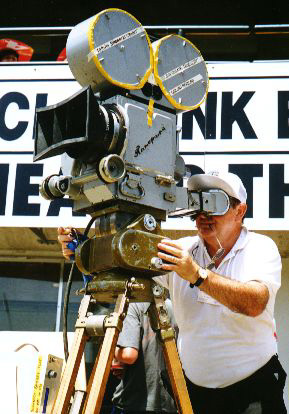 John
R. McLean with a Kinopanorama
camera in Sydney. Copyright Kinopanorama Music & Vision. John
R. McLean with a Kinopanorama
camera in Sydney. Copyright Kinopanorama Music & Vision.Kinopanorama, the Russian system of panoramic cinematography, whereby specially designed three-lens optics recreate the peripheral range of human vision, was developed in the Soviet Union between 1956 and 1957 by scientists at N.I.K.F.I. (All Union Scientific Research Institute of Motion-Picture Photography) under the supervision of Evsei Mikhailovich Goldovskii (1903-1971), the eminent Soviet scientist and inventor. Kinopanorama features several improvements compared with the American built three-lens, three-strip panoramic systems, including interchangeable optics (various focal lengths of 27, 35, 50, 75 and 100mm) of three lenses set on a horizontal plane, so that the optical axes of 48 degrees displacement relative to the central lens enables, depending on the focal length used, photographic angles of between 30 and 165 degrees to be shot; and a six sprocket (28 x 25mm frame) pull-down mechanism in which all three films remained in complete synchronization on a common plain during filming. "Jitter", a term coined to describe instability of three-strip films in the Cinerama and Cinemiracle cameras, has been reduced to less than 10 microns (imperceptible to the human eye) in the Kinopanorama camera. |
More
in 70mm reading: |
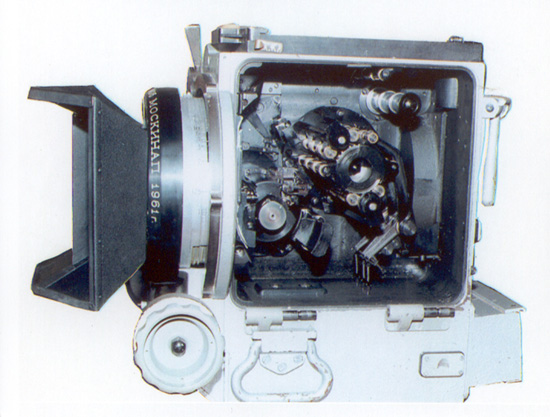 Kinopanorama
camera. Copyright Kinopanorama Music & Vision. Kinopanorama
camera. Copyright Kinopanorama Music & Vision.The second generation (model PSO 1961) Kinopanorama camera, which has been purchased by Fifth Continent Movie Classics, also features a through-the-lens viewfinder, an optical advantage (not present in the two American systems) which enables the cinematographer to accurately frame the scenes being photographed. |
|
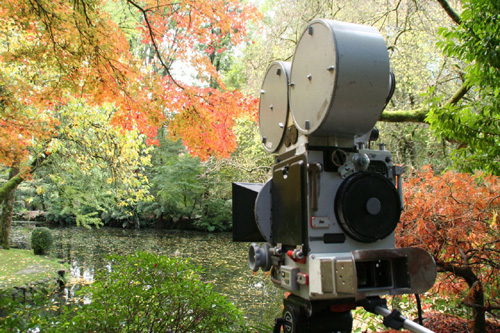 Kinopanorama
camera. Copyright Kinopanorama Music & Vision. Kinopanorama
camera. Copyright Kinopanorama Music & Vision.The frequency of filming at 25 frames per second (as opposed to 24 or 26 in the Cinerama & Cinemiracle systems) is a more convenient arrangement, since most film cameras operate at the 220 volt AC frequency of 50 Hz. This speed may, however, be adjusted to either 24 or 26 frames per second when Kinopanorama films are exhibited in cinemas equipped with Cinerama projection equipment. The camera may be operated with either a DC motor, connected to 2 x 12-volt automotive batteries, or a generator powered AC Synchronous motor. The former is advantageous when slow-motion or high-speed photography is required without sound. The latter, on the other hand, permits synchronous live recording with various multi-track analogue or digital sound equipment presently available to film producers. The first Kinopanorama film "Great is my Country" was premiered at the specially built and designed Mir (Peace) theatre in Moscow on February 28, 1958. Less than a dozen films were filmed in Kinopanorama. |
|
|
Go:
back
- top
-
back issues Updated 22-01-25 |