


Technirama on wheels |
This article first appeared in |
| Reprinted from: Kinematograph Weekly, September 29, 1960 | Issue 61 - June 2000 |
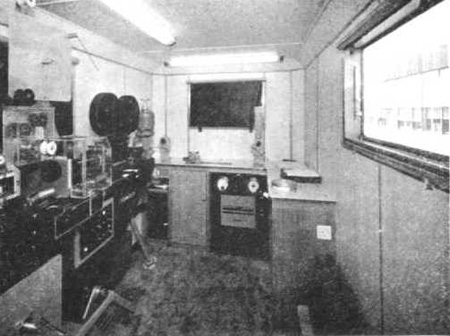 Although for many years it has been common practice to send production camera units from one location to another to shoot "on location", the Technirama mobile printer is probably the first example of similar operations for commercial laboratory work. Although for many years it has been common practice to send production camera units from one location to another to shoot "on location", the Technirama mobile printer is probably the first example of similar operations for commercial laboratory work.Until it's introduction, Technirama negative shot in Europe could only be processed and rush-printed at the Technicolor laboratories in London, Paris or Rome, where the special anamorphic printers needed were available to make 35mm prints of CinemaScope format from the double frame photographed in the Technirama cameras. Many Technirama features have been produced in studios in other countries, particular in Germany and Spain, but it has been realized that sending negative for processing to a different country, even by air, involves a delay which could be inconvenient for the producer who normally expects to see his rush prints on the day following photography. In the spring of 1960, therefore, F. George Gunn, joint general manager of Technicolor Ltd., initiated the project of building an anamorphic printer in a mobile caravan which could be sent "on location" to operate anywhere in the world at any film processing laboratory equipped to develop color negative. Technirama cameras use 35mm negative stock and therefore it is only the special printer which is needed to supplement the laboratories existing processing equipment. The first problem to be solved was one of size and weight: normally Technirama optical printers are of massive construction incorporating a 6 ft bed, similar to the bed of a precision lathe, to allow the accurate and rigid mounting of the optical components. No accuracy could be sacrificed to lighten the equipment, but eventually an accurate bed of hollow, box section was devised and this was mounted on a stand in the form of an inverted triangle so as to avoid distortion. The point of the triangle is mounted on trunnions forming part of the wheel-base of the caravan in which the printer was to be operated. In order to make sure that the caravan should be of the smallest possible size and that every inch of space could be used without inconvenience, a full size model of the interior was built at Technicolor and the size and arrangement tried out and modified until the best possible result was found. |
Further in 70mm reading: The
Technirama Story
|
Self-contained |
|
| Then came the question of the services to be provided. from the start it was decided that the whole unit should be as self contained as possible, making the minimum demand for services on the laboratory where it was working. In fact, all that is required is the electrical power supply and this can be fed in at any voltage likely to be found in Europe, since an elaborate conversion system and control panel provides all the varieties needed for the equipment: 120V accurately controlled for the printing lamp, 230-250V standard frequency for the main drive motor, 24V DC for the relays and solenoids of the electric controls, 15V DC for the take-up motors and 15V for the inspection lamps used to examine the negative during it's running through the machine. Processed color negative is a valuable and delicate material and should only be handled in an atmosphere free from dirt, neither too hot nor too cold, too dry nor too moist. Since the caravan would be standing in the open, exposed to conditions as varied as December in Berlin and August in Madrid, this meant that the air-conditioning unit had to be installed and the walls well insulated, to provide filtered air at 70 deg. F whatever the outside conditions. Prints from the Technirama negative must be made optically and it is well known that this process normally makes negative grain and surface scratches much more apparent; to eliminate this effect Technicolor has installed liquid printing on all it's optical printers and it was essential that this improvement should be available on the mobile unit. This need further extended the range of services to be provided, since not only was a circulation system with pumps and reservoir needed for the special liquid used to coat the negative, but the removal of the liquid from the film after printing required compressed air squeegees, vacuum nozzles and a separate exhaust ventilator to be added to the equipment. |
|
Dark room |
|
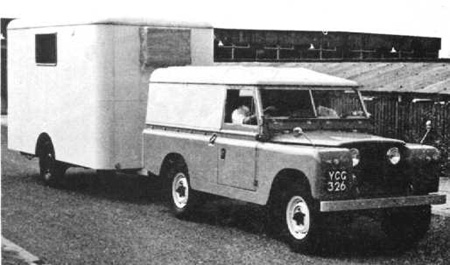 For handling of rolls of developed negative, a rewind bench with a splicer, footage-counter and illuminated inspection box is built into one end, while at the other end of the caravan is the bench used for loading and unloading the positive film stock in the magazine used on the printer. For this operation, the caravan can be made a light-tight darkroom by blinds sealing the windows. For handling of rolls of developed negative, a rewind bench with a splicer, footage-counter and illuminated inspection box is built into one end, while at the other end of the caravan is the bench used for loading and unloading the positive film stock in the magazine used on the printer. For this operation, the caravan can be made a light-tight darkroom by blinds sealing the windows.These are also useful when darkening the interior for the projection of short test print clippings, which can be thrown on a test screen which allows two frames to be shown side by side for comparison. When not in use the screen rolls up into a case in the ceiling. An interlocked pass-box is built into the wall so that rolls of developed negative can be delivered and printed rolls collected without disturbing the operator in the caravan while he is printing and loading magazines. The interlocked doors of the box prevent light getting in while it is being used as a darkroom. A final touch of luxury is provided by a built-in wash-basin with it's own water supply. Overall the caravan is 17 ft. long and 6 ft. wide and when loaded for transit weighs 1 ton 18 cwt. It can be set up on any reasonable flat piece of ground able too take the load and can be connected by cable up to 80 yards in length to any electrical power point capacity 6kVA Drawn by it's Land-Rover, it recently left England for Italy, where it was first demonstrated during the course of the Venice Film Festival. |
|
| Go: back
- top - back issues Updated 22-01-25 |