


The D-150 Super Curvulon Lens |
Read more
at in70mm.com The 70mm Newsletter |
| Written by: Dick Vetter | Date: March 18, 2004 |
 Lens
picture by Thomas Hauerslev, February 2004 Lens
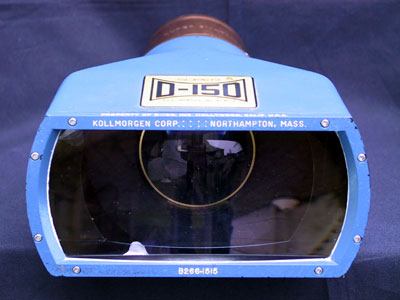
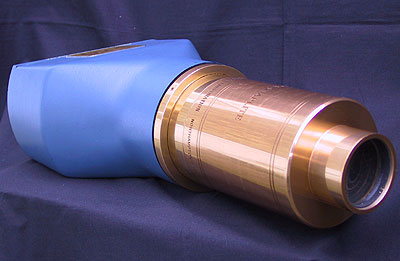
picture by Thomas Hauerslev, February 2004The D-150 Super Curvulon lens attachment was a basic design that I conceived and submitted to Kollmorgen Corp. in 1964 and that company was commissioned by D-150 to perform the final design and fabricate prototypes. Lead man at Kollmorgen was Glenn Berggren. Basic specifications were as follows: 1) An adjustable magnifier to be coupled with all high quality prime projection lenses whose focal lengths ranged between 4 inches and 6.5 inches 2) To comprise two doublets (four elements) of which the inner is positive and the outer is negative 3) The power of magnification was adjustable between 1.6X and 2X depending on the selected spacing between the two doublets 4) Curvature of projection field ranged between 150 degrees screen curvature to a flat screen plane, depending on spacing distance between the two doublets 5) At 1.6X magnification, field curvature was 150 degrees for a 70mm film frame whose width was specified as 1.913 inches |
Further
in 70mm reading: Dimension 150 D-150 Curvulon and Kollmorgen Internet link: Kollmorgen |
 Lens
picture by Thomas Hauerslev, February 2004 Lens
picture by Thomas Hauerslev, February 20046) Conversely, at 2X magnification, the projection field was flat 7) Projection fields varying between 150 degrees and flat were selected according to formula by varying the spacing between the doublets and selecting the appropriate prime lens focal length 8) in practice, the formula functioned on the a) focal length of prime projection lens, b) projection distance, c) screen width and d) screen curvature. A typical setup for a D-150 presentation where screen curvature was 120 degrees used a 1.75X magnification factor combined with a prime projection lens where the focal length of the prime lens divided by 1.75 yielded a net focal length appropriate for the particular installation. Example: Required net focal length about 2.75 inches (about 70 mm), a 4.75 inch prime lens combined with a D-150 Super Curvulon magnifier set at 1.73X magnification yielded the correct net focal length, field curvature and screen image width with precise focus center to edge. The system worked well with consistent reliability. |
|
About Richard Vetter |
|
 Lens
picture by Thomas Hauerslev, February 2004 Lens
picture by Thomas Hauerslev, February 20041. I was appointed Director of the Todd-AO Camera Department in 1963. The main object was to update the 65mm system, to continue to provide equipment and services to the film industry and to integrate the cameras with Dimension 150 optical and projection systems. Between 1963 and 1971 several features were produced and released (Sound of Music in Todd-AO, The Bible in D-150, Hello Dolly in Todd-AO, Patton in D-150, The Last Valley in Todd-AO and Baraka in Todd-AO. Between 1969 and 1984 several World's Fair pictures were produced in D-150, Todd-AO and StereoSpace 3-D. 2. In the late 1960's we perceived that 70mm releases were fading and decided to develop a 35mm anamorphic system. In conjunction with NAC of Japan, I invented a superior optical system for which we received an Academy Award for its superiority: Todd-AO 35. Roman Polanski was the first to produce "Macbeth" in our new 35mm version in 1972. Sam Peckinpah, Dino de Laurentiis and other prominent producers used Todd-AO 35. The 35mm equipment and lenses were sold to Cinema Products in the late 1980.s. Todd-AO 35mm lenses continue to be used by Dino de Laurentiis and other producers. Over 40 feature films have been produced using Todd-AO 35 lenses. 3. I was concurrently Vice President and Technical Director for United Artists Theatres (parent owner of Todd-AO) from 1970 to 1997. We received numerous patents for improvements to production and exhibition equipment and systems. 4. Many skilled individuals contributed to Todd-AO: Mike Todd (the genius behind Todd-AO), Marshall and Robert Naify, Paul Neilsen, Douglas Fries, Dan Lemeiter, Darryl Gray, and the list goes on and on. |
|
|
Go: back
- top - back issues
- news index Updated 22-01-25 |
|