


“The Brutalist" - International Press Notes |
Read more at in70mm.com The 70mm Newsletter |
| Written by: International Press Notes kindly supplied by UIP, Copenhagen | Date: 08.01.2025 |
 The
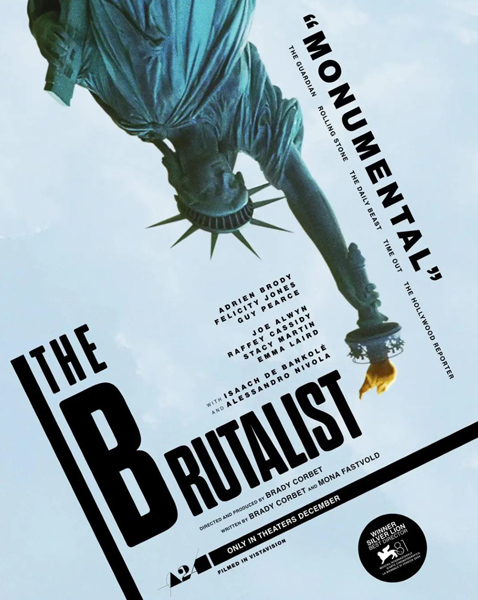
Delphi Filmpalast am Zoo, Berlin, Germany. Picture: Gerhard Witte THE BRUTALIST **Official Selection – Venice Film Festival** **Winner of the Silver Lion for Best Directing – Venice Film Festival** **Official Selection – Toronto International Film Festival** **Official Selection – New York Film Festival** Directed by Brady Corbet Written by Brady Corbet and Mona Fastvold Starring Adrien Brody, Felicity Jones, Guy Pearce, Joe Alwyn, Raffey Cassidy, Stacy Martin with Isaach De Bankolé and Alessandro Nivola 215 minutes Unrated US/ UK/ Hungary English, Yiddish, Hungarian, Hebrew, Italian Color Escaping post-war Europe, visionary architect László Toth arrives in America to rebuild his life, his work, and his marriage to his wife Erzsébet after being forced apart during wartime by shifting borders and regimes. On his own in a strange new country, László settles in Pennsylvania, where the wealthy and prominent industrialist Harrison Lee Van Buren recognizes his talent for building. But power and legacy come at a heavy cost... |
More in 70mm reading: “The Brutalist”: The 70mm Presentations “The Brutalist" About the 70mm Prints The Paramount VistaVision Process Horizontal VistaVision Projector in70mm.com's page about VistaVision in70mm.com News Peripheral Vision, Scopes, Dimensions and Panoramas in70mm.com's Library Presented on the big screen in 7OMM 7OMM and Cinema Across the World Now showing in 70mm in a theatre near you! 70mm Retro - Festivals and Screenings |
Production Notes |
|
 It’s
not the journey, it’s the destination. From writer-director Brady Corbet (Vox Lux, The Childhood of a Leader), winner of the Silver Lion for Best Director at the 2024 Venice Film Festival, comes the story of László Tóth, a Hungarian-Jewish architect who, after surviving the Holocaust, emigrates to the United States to begin a new life while awaiting the arrival of his wife, Erzsébet, trapped in Eastern Europe with their niece following the war. What László finds upon his arrival in the West is an America far different from the one he expected. The promise of the American Dream proves to be illusory as his stature and reputation as a successful architect in Budapest do not translate to his blue-blood Pennsylvania surroundings. “László Tóth is a Jewish Hungarian architect who flees Europe after the war and comes to America to start a new life and re-connect with his wife who he has been forcibly separated from,” says Adrien Brody, who plays the lead role in The Brutalist. “It’s a journey of a refugee connected to his past who has also been stripped of his past. He’s trying to find his way in a new land with a new set of rules.” “It examines how the immigrant experience mirrors the artistic one in the sense that whenever one is making something bold, audacious or new — like the Institute László constructs over the course of the film — they are generally criticized for it,” says Corbet, who spent seven years making the film. “And then over time they are lionized and celebrated for it.” Adds Mona Fastvold, who co-wrote The Brutalist, as well as Corbet’s features The Childhood of a Leader and Vox Lux, “We loved the partnership, friendship, and love story that developed between László and Erzsébet as we wrote the screenplay. These were the first sparks and ideas that became The Brutalist.” |
|
 The
Foundation Brutalist architecture came into style in the United Kingdom in the 1950s, among the reconstruction projects of the post-war era. Minimalist constructions showcasing bare elements like exposed concrete or brick, Brutalism emphasizes structural elements over decorative design, as demonstrated in the works of Le Corbusier, Marcel Breuer, William Pereira, Moshe Safdie, Denys Lasdun, and Alison & Peter Smithson. Corbet and Fastvold became fascinated by Brutalist architecture for its physical and psychological resonance. “For us, post-war psychology and post-war architecture — including Brutalism — are linked, something we bring to life in the movie through the construction of the Institute, a manifestation of 30 years of trauma in László Tóth, and the ramification of two World Wars,” says Corbet. “We found it poetic that the materials that were developed for life during the war were then incorporated into residences and corporate projects in the ‘50s and ‘60s by the likes of Marcel Breuer and Le Corbusier.” Adds Corbet: “Brutalism can be austere but it’s also monumental in style — these strange objects that are loved and loathed in equal measure and take time to unfold in the public imagination because people can’t seem to figure them out in the moment. This for me mirrors the immigrant experience — and Brutalism is a style of architecture that was predominantly created by immigrants. In scope and scale, Brutalist buildings are begging to be seen — but the people who designed or built them were fighting for their right to exist.” Corbet has made two previous features, both historical movies: The Childhood of a Leader (2015), the story of a young American in France who grows up to be a fascist dictator, was set between 1918 and 1940; his follow-up, Vox Lux (2018), took place between 1999 and 2017, tracking the rise of a female American pop star against a backdrop of gun violence and the 9/11 terror attacks. Corbet’s features wrestle with defining moments of the 20th century. The Brutalist, his most expansive work to date, focuses mainly on the mid-century era in American and European life — the decade immediately following the two World Wars. “It’s a time period that has always fascinated me, primarily in the way that post-war psychology had this extraordinary imprint and influence on post-war architecture,” says Corbet. “Something all three of my movies have in common is that they are very much about the cyclical nature of history. The Brutalist is a historical film, and the characters are written to their circumstance. The film has much to say about the immigrant experience in America, and how the American Dream fails László and Erzsébet Tóth.” While researching The Brutalist, Corbet consulted architectural scholar Jean-Louis Cohen, whose works on Le Corbusier and Frank Gehry are widely respected. Visiting him at Princeton, where he teaches, Corbet asked Cohen if he knew of a real-life figure in history who established an architecture firm in one part of the world, only to experience displacement and exile in the war that forced the designer to start over again abroad. Cohen couldn’t name anyone, so Corbet and Fastvold set about creating the fictional components that became László and Erzsébet Tóth. “The story chronicles 30 years in the life of an architect that was well established before the Second World War,” says Corbet. “He and his wife get stuck in the quagmire of war and emigrate separately to America — László in the late ‘40s and Erzsébet in the late ‘50s. The Brutalist is essentially about László trying to re-establish himself in America after being separated from his wife for a decade.” While a figment of Corbet and Fastvold’s imagination, László’s experiences in America reflect those of key artists of The Brutalist movement, including Louis Kahn, Mies van der Rohe, and most of all, the Hungarian-born Marcel Breuer, who designed the Whitney Museum in New York City, now the Met Breuer. “The truth of the matter is that most Eastern or Central European Jewish architects that got stuck in Europe during the war did not make it out alive,” says Corbet. “In Breuer’s case, he was a well-regarded academic who was invited to work with Walter Gropius in America in 1937.” As they researched and wrote, Corbet and Fastvold became interested in Breuer’s relationship with his wife — not to mention his volatile relationship with his own critics, who were often merciless towards his work in both Europe and America. “In the latter part of his life, Breuer was not a particularly celebrated architect,” says Corbet. “Now he’s considered to be one of the finest architects of the 20th century.” The Brutalist is the story of how the American Dream becomes toxic in the eyes of both Tóths after László meets and accepts the patronage of the wealthy industrialist Harrison Lee Van Buren, in exchange for constructing a memorial to Van Buren’s late mother on the oligarch’s sprawling Pennsylvania property. Over the course of the film, that monument becomes a testament to Tóth’s genius, his struggles in the war, and the epic battle he engages in with the capitalist Van Buren to get it made. |
|
 The
Players One of the major challenges of the production was putting together an acting team skillful enough to meet the emotional and technical demands The Brutalist presented. “There were so many cast members in this one, with new groups of people arriving on set every day, but we got very lucky because we had an ensemble of performers who understood the material implicitly and came prepared,” says Corbet. “They helped make a difficult and seemingly impossible process come together smoothly.” In a story that features multiple languages, dialects and accents, including Hungarian, with some monologues playing out across multiple pages in the script, lead actors Adrien Brody and Felicity Jones had to learn to speak Hungarian, a notoriously difficult language to master, and then incorporate Hungarian accents into their predominantly English-language dialogue. Brody was no stranger to historical material and Eastern European accents, having won the Academy Award for Best Actor in 2003 for playing Polish-Jewish composer and Holocaust survivor Wladyslaw Szpilman in The Pianist. Says Brody, “For me to inhabit László Tóth, I had to build a character based on a foundation of truth. I pulled from two profound influences in my life growing up the son of a Hungarian refugee, and representing Wladislav Szpilman’s memoirs as recounted in The Pianist; although they are two entirely different characters, the months spent researching and connecting with Szpilman‘s past, and the horrors of that era, still haunt me and offered an emotional understanding to the harrowing experiences and loss that inform László’s journey coming to America as a refugee.” Brody’s connection to Hungary preceded the film. His mother, the photographer Sylvia Plachy, was born in Budapest and was forced to flee as a young girl amidst the Hungarian revolution in 1956. She became a refugee and emigrated to America, and much like László, pursued her dreams of becoming an artist. “I saw The Brutalist as a story of quiet perseverance and the need to strive for excellence,” says Brody. “Even when the ground has been ripped out from underneath you.” Adds Brody: “It’s wonderful to have a storytelling approach that allows enough time with a character to see and experience a life in total, which is what Brady and Mona have achieved in The Brutalist. Oftentimes you jump into the action and things happen in a story — but you don’t know the person you’re on the journey with. This film encompasses a 30-year span of one man’s life.” Felicity Jones felt a similarly strong connection to Erzsébet Tóth as soon as she read The Brutalist. “I engaged with this one right away and thought it felt like it came from another time — but it also had this contemporary, razor-sharp feel to it,” says Jones, who was nominated for an Academy Award for her performance as Jane Hawking in The Theory of Everything. “The story also charts how surviving life in a concentration camp carries waves of repercussions across the years,” Jones continues. “There’s a lot of violence in the movie — both emotional and physical — but it was the combination of violence, humanity, and romance, that really locked me into The Brutalist.” “Erzsébet appears at the mid-point of the movie after having been separated from László for many years,” says Jones. “When they see each other at the train station, it’s an extraordinary moment because it’s her love for him that has helped her get through the years of trauma she suffered in the Holocaust.” Jones spent months mastering the character’s Hungarian accent and delving into the darkest corners of Erzsébet’s life to bring to life on screen her overwhelming pain and suffering. But it was the deep and loving bond between László and Erzsébet that helped her create such a complex and nuanced character. “She has such an unflinching honesty and she’s so observant in the way she takes everything in after she arrives in America and reunites with her husband,” says Jones. “Over the course of the movie you see her become healthier and more confident and spirited. There was a huge amount of range to explore and play in her. The love she and László share enables her health to physically improve.” “Felicity is such a gifted actor, she brought a beautiful quiet strength and truth to the character that served as pillar of support for László,” says Brody. “She represents the powerful force of a partner who can hold the family together under the most extreme duress, all the while enduring the turmoil of a very passionate artist as he strives to leave behind a body of work. Erzsébet manages to support Lazlo despite her own suffering, and Felicity brought something very truthful and moving to that.” In her absence from László, Erzsébet focuses her energy on protecting his sister’s child, the delicate young woman Zsófia, played by Raffey Cassidy. “Erzsébet relies on Zsófia and both women serve as emotional crutches for each other, more so Erzsébet than Zsófia,” says Jones. “The two women have a communication and language that is special between them — something that goes beyond speech.” Returning to the Corbet fold after a dual role in Vox Lux, playing Natalie Portman’s character in her early years, as well as Portman’s daughter in later scenes, Raffey Cassidy has come of age in the works of Brady Corbet. “She had the lead role in Vox Lux, split with Natalie, and it’s interesting seeing her six years later as an adult, tackling this very challenging character that has so much depth and darkness to her,” says Fastvold. “It’s wonderful to see that transformation.” Darkness is the common denominator in many of the characters in The Brutalist, but the character who hides his darkness in plain sight is the suave and mercurial industrialist Harrison Lee Van Buren, played with debonair menace by veteran actor Guy Pearce. Outwardly a progressive businessman who is building his legacy on a sprawling estate in rural Pennsylvania, he becomes both Tóth’s savior and tormentor over the course of a story that spans multiple decades. “One of the things I enjoy most about acting is that tightrope you walk between different personality traits and psychologies,” says Pearce, who brings a shifting temperament to the film’s most ferocious and symbolic character. “He’s a man of a particular era who is smart, driven and has a passion for success; he knows what it means to be a man in a powerful world.” Pearce was also drawn to the tenderness in Harrison Van Buren, which is only viewed in small glimpses, and which the actor likened to a little boy. But it was the character’s mercurial nature, combined with a thirst for power and control, that gave Pearce the most to work with when he was creating his performance. “Part of his power is to be charming and win people over,” says Pearce. “He’s troubled, but there’s also a big heart in there, someone who is willing to financially support a struggling immigrant like László, whose architectural talent he recognizes. He’s got taste, and if he has power over everyone around him, everything is OK. His entire façade is constructed around that.” In the relationship between Harrison Van Buren and László Tóth, The Brutalist also confronts the uneasy question of who enables art — and the impact the patronage system can have on an artist and his vision. “We were interested in telling a story about an investor or benefactor and the artist he hires to create,” says Fastvold. “And how complicated that relationship can be.” To bring to life the complexities of Van Buren, Pearce had to understand the nature of appearances in the rarefied world of a mid-century American industrialist of the oligarch class. Outwardly accommodating, but prone to bouts of rage and violence, Van Buren becomes a symbol for capitalism’s most egregious excesses. “The way in which someone like Van Buren presents himself in dress and demeanor is very telling, and Kate Forbes’ costumes were stunningly tailored, because there’s a flair to him,” says Pearce. “Hair and makeup artist Gemma Hoff fashioned a wig and mustache for me, and we used a shock of silver hair that aged the character up and gave him a certain authority. There’s a dapper and old-fashioned film-star quality that goes with Van Buren’s charm, strength and power. When I put the costume on, I was thrust into the character.” Playing Van Buren’s adult children, Harry Jr. and Maggie, actors Joe Alwyn and Stacy Martin bring contrasting ambiguity to a deeply complex family. Both adult children strive to please their father in different ways, in a desperate bid for his affection and respect. “Stacy Martin is an actress we’ve worked with now on multiple projects and it’s wonderful working with people over and over again because you can give them a gesture and they know exactly what to do,” says Fastvold. “Joe Alwyn is someone we worked with for the first time, and when I first started watching dailies, I saw an almost Trumpian quality to his performance.” |
|
|
Building the Institute The Brutalist deftly re-creates rural and urban American life in mid-century Pennsylvania, requiring a production design that was specific to both era and setting. It also required creating the towering and heavily symbolic architectural vision known as the Institute, which László builds in fits and starts on a Pennsylvania hill over the course of many years. “The film is about many things, including building a building, but it’s also a movie about making a movie,” says Corbet. “Architecture and filmmaking have a lot in common because it takes roughly the same amount of people to construct a building or make a movie. The Brutalist for me was a way of talking about the more bureaucratic aspect of the artistic process.” Production designer Judy Becker already knew mid-century America having designed Todd Haynes’ Carol, set in mid-century New York City. The Brutalist follows a similar trajectory, through mid-century New York City and Philadelphia, detouring into rural Pennsylvania, and culminating in Venice during the film’s stirring 1980’s-set epilogue. “I was pursuing this project before I even got the script because for a designer, making a movie about an architect is a dream come true,” says Becker. “I also happen to love Brutal- ist architecture, and the major challenge with this one wasn’t simply designing period-specific sets and locations, but constructing the Institute, which symbolizes László’s lived history and struggle.” Becker had to create a design that not only looked authentically Brutalist, but resembled something a Bauhaus-trained architect might have concocted in real life. The construction also had to be achievable within the production without being an actual building — which required no small amount of movie magic on the design team’s part. “The crux of the movie is the problems László runs into in the course of designing and building the Institute, but it’s not strictly a question of architecture, design or construction, because it relates to bigger issues,” says Becker. “When someone is paying your way, like Harrison Lee Van Buren is funding László’s vision, how much power do they actually have over you?” To build the Institute, Becker researched Brutalist and Modernist architects and their commissions, but also relied on people, things and events specific to her background. “The structure needed to relate visually to a concentration camp, so I studied images of the camps, which was upsetting but necessary to understand László’s history,” says Becker. “When I was a child growing up in New York, I remembered our local synagogue, which featured a Star of David overhead. It was a huge moment for me when I realized that the Institute should be in the shape of a cross, towering above the building’s lower feature, which look like concentration camp bunkers.” László’s design skills in The Brutalist are first showcased through the furniture he creates for his cousin Atilla’s Philadelphia business. Planning how those items looked again fell to Becker. “I had to wear many hats on this project which I’ve never worn before, even beyond designing buildings as an architect would,” says Becker. “László also designs a huge cabinet system for Van Buren’s library, which became a chance for me take all my sources of design inspiration and bring them to life in the movie.” |
|
 The
Way They Wore Costume designer Kate Forbes (Fair Play) received The Brutalist script in late 2022 and immediately connected with the scope and scale of what was at heart a very modest production. “I loved the way Brady and Mona mingled humor with darkness,” says Forbes. “The greatest challenge was delivering all the time periods the movie covers within a tight budget while filming primarily in Budapest, my first time working there on a feature.” Corbet wanted an unaffected authenticity to the costumes in The Brutalist, while also paying tribute to movies and stars of the post-war era, prompting the British-born Forbes to watch dozens of movies, visit costume archives, and gain a firm understanding of the American mid-century aesthetic, which differed from the European style of the era. During pre-production, she sourced costume houses in London, Paris, Madrid and Berlin, amassing rails of clothing for the main characters as well as the extensive background cast. “My process has always been firstly to be informed by existing garments, finding inspiration there, and then making any specific garments that cannot be found,” says Forbes. “Given the time and budget limitations on The Brutalist, we worked almost entirely using original pieces, replicating only a couple of period suits and shirts for the principal cast. Prior to production, we sent 20 crates of costumes from London to Budapest as well as vanloads from Berlin and Madrid to begin the fittings.” One challenge for Forbes was finding costumes in Europe that were tailored in the American style of the era; another was finding clothing in presentable condition. “So many garments from that period are no longer in great shape, or camera-ready” says Forbes. “Making sure everything looked immaculate was key, especially for scenes featuring the wealthy Van Buren family.” For Forbes, dressing Adrien Brody as László Tóth was a particular delight, placing him in knitwear as much as possible to accentuate his lanky frame. “Adrien has a fantastically angular physique, and we wanted to bring that to the fore, emphasizing the physical hardship he lived through during the war in Hungary,” says Forbes. “There is something softer and almost vulnerable with knits, as opposed to suits and jackets, which felt more authentic for László, especially at the start of his journey, and later when he encounters the expensively tailored Van Burens.” For Lázsló’s style, Forbes focused on looks from the mid-1950s, taking sartorial inspiration from the Beat Generation and screen idols like Gregory Peck, using V-cut sports jackets and knitwear to telegraph the character’s independence and lack of conformity — it’s no mistake that László isn’t shown wearing a suit until the film’s final frames. “During our first fitting, I convinced Adrien that László would never wear a suit and tie — not because he is so defiantly apart from the more conventional characters in The Brutalist, but because his Bauhaus education and modernist vision lends him this timeless modernity,” says Forbes. “So much of László’s wardrobe was about finding the right pieces that reinforced his mental state in all his ups and downs.” In Forbes’ hands, the monochromatic colors and lack of adornment in László’s style of dress was both intentional and symbolic. “Having something that felt ‘missing’ in his attire was an intuitive and subconscious nod to the modernist furniture, interiors and buildings he was designing,” says Forbes. “The confrontation of modernism by way of the nostalgic architecture that preceded it was an important aspect of our protagonist’s appearance.” Contrasting László’s outsider silhouette is the brute force presence of Harrison Lee Van Buren, representing dynastic wealth and rapacious capitalism at its most brazen and flamboyant. Inevitably, the two characters engage in a symbolic battle that turns ferocious in the stone quarries of Cararra, Italy. “Harrison is a titan of industry who is playing the capitalist game, and who lacks Laszlo’s creative talent,” says Forbes. “Because the Van Burens have significant means, his dress — while not especially showy — is expensive but conventional. He’s a character who would secretly love to possess the same irreverent charm as Laszlo does — but despite all his charisma, he simply doesn’t, so his sartorial confidence comes from hiring the most expensive tailors. He wants people surrounding him to know his monetary wealth, power and status.” Once Forbes had looks and costumes locked in for the main characters, she turned to the difficult task of dressing the background cast of The Brutalist, which numbered in the hundreds. This meant arriving on set in the early hours of the morning to meticulously dress the day players in the right suit, dress, and even underwear. “Their costumes had to be as considered and consistent as the principal cast or the entire illusion could have easily collapsed,” says Forbes. “God bless the extras and all they bring to a production!” Forbes also reached out to workwear brands like Levi’s and Pendleton to secure product placement, particularly for scenes set on or around building sites. “So much of the film was set on construction sites so to have these classic American brands come on board that were so prominent in this landscape at the time was a tremendous help in terms of making the budget stretch that much further,” says Forbes. |
|
 Dramatic
Vistas Working from Corbet and Fastvold’s 168-page script, the team shot on average 7 to 10 pages per day, with much of the production filming in Hungary, where Corbet filmed his debut feature The Childhood of a Leader ten years ago. With the action on screen playing out mostly in America, the bulk of the filming on The Brutalist took place in Budapest, where lead actor Adrien Brody has family roots. “Filming here helped ground my work in way that would have been very different if we’d shot on location in Pennsylvania,” says Brody. “Budapest is such a beautiful place, and the architecture is amazing — there are beautiful structures at every turn.” Because Brody and Jones speak so much Hungarian dialogue in the movie, Corbet wanted his main players to be surrounded by sights and sounds his characters would have experienced before a world war drove them apart. “Hungarian is such a crazy language, made up of aggressive sounds — just to make the correct shape with your mouth is a challenge for non-native speakers,” says Corbet. “I knew it would be helpful for Adrien and Felicity to be immersed in that environment during their prep period before cameras rolled, even in the present day.” Modernity and the high cost of filming in American cities kept Corbet and his crew in Hungary for much of the three-month shoot. Present day Philadelphia had become so unrecognizable from its 20th century industrial heyday that Budapest became the City of Brotherly Love’s stand-in. “There’s a big freeway bisecting downtown Philly now and the skyline has changed so much — there’s no vantage point, and we would have had to paint things out in post-production,” says Corbet. “Budapest has a lot of neutral architecture, exposed pipes, and warehouses — it’s an industrial city in the way Philadelphia used to be, before it got chopped up and modernized.” Rural Pennsylvania, where the wealthy Van Buren clan resides in a stately mansion on a vast sprawl of verdant land, was easily reimagined outside Budapest, where rolling hills and large estates are a familiar sight. “The Colonial style of architecture we wanted for the Pennsylvania scenes doesn’t exist at all in Eastern Europe, but we were able to obfuscate certain architectural details,” says Corbet. “We were able to do set extensions with very minor visual effects in the movie, usually things operating on the periphery of a scene — which I’m typically averse to because they tend to look inorganic. The pros outweighed the cons filming in Hungary.” Another crucial element in choosing Budapest as the film’s principal location was the fact that Corbet’s epic and sweeping third feature was shot entirely on celluloid film for less than $10 million dollars. “Aside from all the amazing locations in Hungary, there are two film labs in Budapest, and it was easier for us to process our footage locally,” says Corbet. “It gave us peace of mind to be able to deliver our work within 20-30 minutes from our locations.” To bring his epic vision of excavation, building and the immigrant experience to life, Corbet for the third time turned to British-born cinematographer Lol Crawley, who shot both of Corbet’s previous features. “We have a great shorthand,” says Corbet. “He’s a real poet and a great human being.” |
|
 The Brutalist was filmed with different cameras and lenses, in the format
known as VistaVision, which Alfred Hitchcock employed in classic works
including "North By
Northwest" and
"Vertigo". A higher resolution, wide-screen
variant of the 35mm motion picture format,
VistaVision was created by
engineers at Paramount Pictures in 1954 for the premiere of White Christmas
at Radio City Music Hall, during television’s coming-out heyday that had
created a slump in moviegoing. VistaVision became mostly obsolete in the 1960s, as CinemaScope and 70mm rose to prominence as the dominant wide-screen formats; the last American production to film entirely in VistaVision was Marlon Brando’s One-Eyed Jacks in 1961. But the format was employed in international productions throughout the ‘70s and into the 2000s, on Nagisa Oshima’s In the Realm of the Senses (1976), Shohei Imamura’s Vengeance is Mine (1979), and Kim-Jee Woon’s A Tale of Two Sisters (2003), while also being used for special-effects sequences in everything from the original Star Wars movies to Yorgos Lanthimos’ Poor Things in 2023. Corbet and Crawley were drawn to the format for its mid-century origins, and its expansive field of view, which they studied prior to production by analyzing a sequence from Vertigo incorporating a wide expanse of the Golden Gate Bridge. “Its field of view is extraordinary — you could be right up against the side of a building with a 50mm lens on the camera, what you’d normally shoot a human face with, and you can see from the cement to the sky because the field of view is so immense,” says Corbet. “For architecture it’s great because you can be physically close to the structure you’re filming and experience all the details — you can see the minerality of the concrete and at the same time capture the entire building inside your frame.” The drawbacks of shooting in VistaVision included very few cameras left in existence — Paul Thomas Anderson used some on his forthcoming feature after The Brutalist wrapped production — not to mention the overwhelming bulk and weight of the remaining cameras. “It’s a large format, and quite finnicky, which requires technicians who know how to work with it,” says Corbet. “There’s still a culture of shooting on film in Hungary, unlike much of the rest of the world. For us this was a big coup and one of the major reasons why I wanted to film in Hungary again.” For the breathtaking scenes in the quarries of Carrara, Italy, where László and Van Buren travel to source marble for the Institute, Corbet wanted to bring to life the devastating reach of capitalism into every corner of the globe. “Carrara for me is indicative of the way capitalism has been so harmful to the planet, so the landscape mirrors the characters’ interiority,” Corbet explains. “The whole movie is about my characters’ interiority, which is manifested in the spaces László is creating in the movie, and the spaces he inhabits. It also reflects the rapaciousness of Van Buren — a visual reminder of how his ilk devours and plunders everything in their path.” “The element of the environment is always telling and informative in Brady’s work,” says Guy Pearce, whose character reveals the depths of his evil and depravity in the hollowed-out marble caves in the remote Italian mountains. “Shooting in the excavated marble quarries of Carrara was stunning and devastating at the same time.” “Capturing the majesty of Carrara is what VistaVision was created for — those dramatic vistas,” Corbet adds. “But we also came to realize how powerful the human face looked in the format. It was a way for us to access closeups in the style they were achieved in the 1950s, when the camera and format were engineered.” |
|
 Slabs
of Sound The powerful score for The Brutalist needed to be both minimalist and maximalist, in keeping with an overall design vision that became a guiding force for Corbet and his team during the film’s seven-year gestation period. “Depicting architecture on screen is difficult because it’s inanimate, and shooting inanimate objects has never been easy for me — instead of just presenting architecture in the movie, the challenge for us was representing it,” says Corbet. “The Brutalist is both outsized and imposing but it’s also quite austere, and I think the score plays a crucial role in conveying the film’s central themes.” For the score, Corbet turned to British-born experimental musician Daniel Blumberg, who has recorded three albums for Mute Records with the producer Peter Walsh, who helped create many of Scott Walker’s midto late period solo albums, including Climate of Hunter and The Drift, in addition to albums by Peter Gabriel, Simple Minds and Heaven 17. During the film’s seven-year gestation period, Corbet and his crafts teams, Blumberg included, wrestled with how to best represent Brutalism on film, sonically, photographically, and psychologically. “The Institute only reaches completion in the last 25 minutes of a 215-minute movie, so the soundtrack, and even the filmmaking itself needed to reflect The Brutalist method,” says Corbet. “We linger up close on spaces and characters, so when we finally crack wide open in Carrara, and on the construction site as the Institute takes shape, it’s what you’ve thirsted for all along — the psychological effect of finally being able to breathe.” Adds Corbet: “In the same way architecture uses slabs of concrete, Daniel and I wanted slabs of sound for The Brutalist’s score — bars that become resounding and intoxicating, but in a measured, minimalist fashion. Sonic Youth is famous for these verses that last for seven minutes, and choruses that lasts 30 seconds — but the chorus is enriched by how long the listener is required to wait for it. I felt something similar in Marcel Breuer’s buildings, like the Met Breuer in New York City, where instead of entering this palatial lobby, you encounter a restrictive space where there’s just enough room to check your coat under low eight-foot ceilings. Once you get into the main spaces of the building, it cracks wide open.” Prior to production, Blumberg traveled to multiple locations across Europe to record a large ensemble cast of top-tier improvising musicians (legendary players Evan Parker, Axel Dörner and Sophie Agnel among them). He was also present for much of the shoot, capturing key musical sequences such as the nightclub scene live on set. “Brady and I were in constant dialogue about the score from the moment he began writing the script,” says Blumberg. “We were living together and working on demos in the evenings throughout pre-production, and we would work into the night after he came back from set.” Adds Corbet: “There was one thing that was crucial for us in creating the score for The Brutalist, beyond evoking the 1950s by incorporating brass and jazz instrumentation in some of the big orchestral pieces. The big thing for us was the solo piano. I usually find piano to be overly sentimental in film scores, but I wanted this improvisational-style performance that was linked to László’s interior life.” They worked with U.K.-based pianist John Tilbury, widely known for his interpretations of classical composer Morton Feldman. Now in his eighties, Tilbury hosted Blumberg at his home studio in Kent, working together on the solo piano score. “In my view John is one of the most important artists of the 20th century,” says Blumberg. “It felt vital to have such a force throughout the film to mirror László’s character and actions as the years and decades pass.” The film ends in an epilogue set at the Venice Biennale in 1980, where László Tóth is being celebrated for his life’s work. To create the sound of this new era, Blumberg traveled to New York to collaborate with Vince Clarke, who defined the synthesizer-heavy sound of the ’80s through his work in Depeche Mode, Yaz and Erasure. Peter Walsh mixed the score and co-produced with Blumberg. "The film is dedicated to Scott Walker, the composer of my previous two films, who passed away while The Brutalist was in pre-production,” adds Corbet. “I’m pretty sure Scott would have loved this movie, not to mention Daniel’s extraordinary score.” |
|
|
Take A Breather To add air to the The Brutalist’s expansive running time, Corbet and Fastvold incorporated a 15-minute intermission into the script, which arrives at the film’s mid-point, separating into two distinct chapters László’s arrival in America with his wife’s. “It’s a rolling intermission because it’s a long story that plays out across multiple years and decades,” says Corbet. “We didn’t want exhibitors to stop the movie and turn on the lights, which messes with their routine.” For the editing process, Corbet turned to Dávid Jancsó, his collaborator on The Childhood of a Leader as well as Fastvold’s on The World to Come. A Hungarian native, Jancsó is the son of lauded filmmaker Miklós Jancsó, who achieved international prominence in the 1960s for his historical allegories featuring long-sequence shots; the elder Jancsó went on to influence Hungary’s most famous filmmaker, Béla Tarr, who turned Slow Cinema into an art-house phenomenon. “David was a no-brainer for this project because there’s so much Hungarian dialogue, and he has such a unique sensibility in his cutting — he has no trouble letting a scene or sequence breathe,” says Corbet. “So many scenes in the movie feature dialogue and conversation; David went out of his way to distill every scene to its essence.” For Jancsó, László Toth's monumental work in the film became the stylistic reference for how he thought about structuring the film's equally monumental runtime: "The architectural motifs were also mirrored in the editing style," he explains. "The clean, geometric precision of brutalist architecture influenced the cutting patterns, with long, unbroken shots interspersed with sharp, abrupt cuts, creating a rhythm that reflected the tensions in László’s life." It also gave Jancsó opportunity to rewatch and reconsider a wide range of epics from Hollywood and international filmmakers over the last sixty years, films that similarly told something of a generation and a nation by tracking the stories of their ambitious, single-minded protagonists: from Bernardo Bertolucci's chilly and chillingly modernist The Conformist, with "memories and flashbacks woven seamlessly into the present" to Francis Ford Coppola's era-defining The Godfather, which showcased editors "William Reynolds and Peter Zinner’s ability to slowly build tension within quiet, emotionally charged scenes." Jancsó’s deep knowledge of celluloid filmmaking, including shooting in the antiquated VistaVision format, helped Corbet and Crawley develop peace of mind during the film’s 18-month post-production process. “The film couldn’t have been in better hands because David’s technical prowess in the editing room is unmatched,” says Corbet. “Very few people are as dialed into the analog post-production process as David is, which gave Lol a sense of calm when he was handing over the footage. David handled everything with expert gloves.” |
|
Adrien Brody |
|
 ADRIEN
BRODY won the Academy Award and Cesar Award for Best Actor for his portrayal
of real-life Holocaust survivor Wladislaw Szpilman in THE PIANIST, making
him, to date, the youngest person to have received the Oscar in that
category. His performance also earned him Best Actor honors from the
National Society of Film Critics and the Boston Society of Film Critics, and
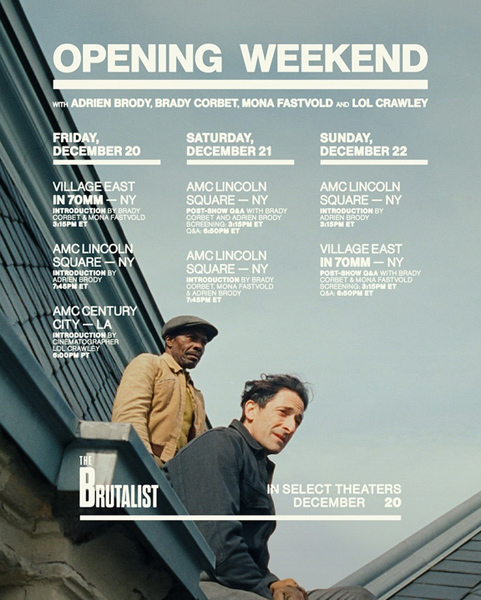
nominations for Golden Globe, Screen Actors Guild and BAFTA Awards. Next up, Brody will star in director Brady Corbet’s upcoming film THE BRUTALIST. Chronicling thirty years of an artist’s life, the film depicts visionary architect László Toth (Brody) and his wife Erzsébet (Felicity Jones) as they flee post-war Europe to rebuild their legacy in America. After its world premiere at the Venice International Film Festival, the film received rave reviews, with Brody’s performance hailed as his “career best” and “electric”, “extraordinary”, and “exceptional”. The film premiered at the Venice Film Festival to huge critical acclaim, with Brady being honoured with the Silver Lion award for Best Director. The film will be released in the US by A24 on December 20th and is released internationally by Universal Pictures (Focus Features) in early 2025. This Fall, Brody is set to make his London stage debut as an innocent man who spent 22 years on death row in THE FEAR OF 13. Based on the extraordinary true story of Nick Yarris, THE FEAR OF 13 is a new play by Lindsey Ferrentino (UGLY LIES THE BONE) directed by Justin Martin (PRIMA FACIE and STRANGER THINGS: THE FIRST SHADOW). The play will run from Oct 4 – Nov 30. Most recently, Brody starred in John Trengove’s first English-language thriller, MANODROME, which premiered at the 2023 Berlin Film Festival and released in November 2023, and Wes Anderson’s ASTEROID CITY, which premiered at the 2023 Cannes Film Festival. The latter broke the record for best per theatre average on its opening weekend. He starred in the second season of HBO’s drama series, WINNING TIME: THE RISE OF THE LAKERS DYNASTY, about the Los Angeles Lakers in the 1980s. Earlier that year, he guest-starred in Rian Johnson’s new crime-drama series POKER FACE for Peacock and Dexter Fletcher’s GHOSTED for Apple TV+. In 2022, Brody starred in Netflix’s BLONDE, opposite Ana de Armas, and Searchlight’s SEE HOW THEY RUN. He also had a pivotal role in the third season of HBO’s hit show SUCCESSION, for which he garnered a 2022 Emmy nomination for Outstanding Guest Actor in a Drama Series. Other recent credits include the series CHAPELWAITE for Epix, which he starred in and executive produced, Wes Anderson’s THE FRENCH DISPATCH, and a role in Steven Knight’s PEAKY BLINDERS on BBC and Netflix. Brody runs a production company under the moniker Fable House Films. Recently, Fable House Films produced and funded the 2022 film CLEAN, which Brody also cowrote, scored, and starred in. The film premiered at Tribeca Film Festival, before being acquired and distributed by IFC Films. Fable House Film’s past slate includes Daniel Lee’s DRAGON BLADE, the Brian DeCubellisdirected MANHATTAN NIGHT (in which Brody also stars), and a documentary he co-directed called STONE BARN CASTLE. In 2015, Brody was Emmyand Screen Actors Guild (SAG) Award-nominated for portraying Harry Houdini in History’s HOUDINI, which debuted as the most-watched cable miniseries of the year. That same year he was seen in Wes Anderson's THE GRAND BUDAPEST HOTEL, which won the 2015 Golden Globe for "Best Picture, Musical or Comedy" and was a 2015 Academy Award “Best Picture” nominee. That February, he co-starred opposite Jackie Chan in DRAGON BLADE, which grossed a stunning $100M within its first two weeks of opening in China. Brody has worked with some of the most prominent film directors in the industry: Paul Haggis (THIRD PERSON); Peter Jackson (KING KONG); Ken Loach (BREAD AND ROSES); Wes Anderson (THE DARJEELING LIMITED and THE GRAND BUDAPEST HOTEL); Barry Levinson (LIBERTY HEIGHTS); Spike Lee (SUMMER OF SAM); Xiaogang Feng (REMEMBERING 1942); and Tony Kaye (DETACHMENT). Some other films in his filmography include: HARRISON’S FLOWERS; LOVE THE HARD WAY; THE JACKET; HOLLYWOODLAND; CADILLAC RECORDS; THE BROTHERS BLOOM; SPLICE; and PREDATORS. Brody first came to prominence when he played a leading role in Steven Soderbergh's KING OF THE HILL and for starring performances in two features for director Eric Bross: TEN BENNY and RESTAURANT. The latter earned Brody an Independent Spirit Award nomination. Brody also has a career as a painter and visual artist. His first collection, “Hotdogs, Hamburgers and Handguns,” debuted at Art Basel in 2015; his second collection, titled “Hooked”, was shown at New York Art Week The following year. His paintings sell internationally, and he’s raised millions for numerous charities through auctions and donations. Additionally, Brody regularly works with luxury brands, including recent collaborations with Armani, Chopard and Montblanc. He has also designed a series of standalone collections for Swiss luxury brand, Bally, which will include ready-to-wear clothing, shoes, bags and other accessories. Brody was born and raised in New York City, where he studied drama at LaGuardia High School of the Performing Arts and the American Academy of Dramatic Arts. |
|
Felicity Jones |
|
 Felicity
Jones is best known for her Academy Award, BAFTA, SAG and Golden
Globe-nominated starring role opposite Eddie Redmayne in James Marsh’s THE
THEORY OF EVERYTHING. Jones can next be seen in THE BRUTALIST alongside Adrien Brody and Guy Pearce, and directed by Brady Corbet. The film premiered at the Venice Film Festival to huge critical acclaim, with Brady being honoured with the Silver Lion award for Best Director. The film will be released in the US by A24 on December 20th and is released internationally by Universal Pictures (Focus Features) in early 2025. Next up, she is set to star in TRAIN DREAMS opposite Joel Edgerton from director Clint Bentley and will also star in Michael Showalter’s holiday comedy OH. WHAT. FUN. for Amazon MGM Studios opposite Michelle Pfeiffer, Chloë Grace Moretz and Dominic Sessa. She last starred in and produced the action thriller, DEAD SHOT directed by Charles and Thomas Guard. In 2021, Jones starred in and executive produced LAST LETTER FROM YOUR LOVER for Netflix, based on the book of the same name by Jojo Moyes. She was also seen starring in Netflix’s THE MIDNIGHT SKY, alongside George Clooney who directed the film as well. In 2019, Jones re-teamed with THE THEORY OF EVERYTHING co-star Eddie Redmayne in Amazon Studios’ THE AERONAUTS, which follows headstrong scientist James Glaisher and wealthy young widow Amelia Wren (Jones) as they mount a balloon expedition to fly higher than anyone in history. Previously in 2018, Jones starred as Supreme Court Justice Ruth Bader Ginsburg in Focus Features’ ON THE BASIS OF SEX directed by Mimi Leder from a Daniel Stiepleman script. The film opened at AFI Fest in Fall 2018. In December 2016, she led the cast of Disney/Lucas’ ROGUE ONE: A STAR WARS STORY. Earlier that year, she starred in Ron Howard’s INFERNO opposite Tom Hanks and J.A. Bayona’s A MONSTER CALLS. Jones’s past film credits include: The Invisible Woman; Rupert Goold’s drama TRUE STORY opposite Jonah Hill and James Franco; BREATHE IN, which reteamed her with director Drake Doremus; and Marc Webb’s THE AMAZING SPIDERMAN 2 with Andrew Garfield and Emma Stone. Her extensive TV credits include the critically acclaimed BBC adaptation of THE DIARY OF ANNE FRANK a guest-starring role on HBO’s hit series GIRLS; and Jane Austen’s NORTHANGER ABBEY. Born and raised in the UK, Jones started her acting career as a young child, while continuing to pursue her education and eventually receiving a degree from Oxford. American audiences first took notice of her in 2011 as the star of Drake Doremus’ LIKE CRAZY, in which she appeared opposite Anton Yelchin. The film debuted at the Sundance Film Festival to critical acclaim, earning the Grand Jury prize for American Dramatic Film and Jones a Special Jury Award for acting. She also was named Breakthrough Actor at the Gotham Awards and Breakthrough Performance by the National Board of Review. |
|
Guy Pearce |
|
 Guy
Pearce's career has spanned nearly four decades in film, television and
theatre, both in Australia and internationally. Pearce first made his mark
on screen in the successful Australian TV series Neighbours. From here, his
film work in Australia has been extensive, including Stephan Elliott’s
box-office sensation THE ADVENTURES OF PRISCILLA: QUEEN OF THE DESERT, and
John Hillcoat’s powerful drama THE PROPOSITION, written by Nick Cave. In
2014 he starred in David Michôd’s THE ROVER with Robert Pattinson, marking
his second collaboration with Michôd after the international hit Animal
Kingdom. Other Australian credits include Neil Armfield’s HOLDING THE MAN;
Pauline Chan's 33 POSTCARDS; a second collaboration with Stephan Elliot in
SWINGIN’ SAFARI; and TILL HUMAN VOICES WAKE US with Helena Bonham Carter. Pearce had his international break in the critically acclaimed L.A. CONFIDENTIAL starring alongside Russell Crowe, Danny de Vito and Kim Bassinger. The film received nine Academy Award nominations including Best Picture. This paved the way for a number of iconic roles in films such as Christopher Nolan’s MEMENTO; John Hillcoat’s LAWLESS; Ridley Scott’s PROMETHEUS and ALIEN: COVENANT; and Oscar winners THE HURT LOCKER and THE KING'S SPEECH. Pearce’s other film credits include IRON MAN 3; RESULTS; LOCKOUT; BREATHE IN; DEATH-DEFYING ACTS with Catherine Zeta-Jones; EQUALS; RULES OF ENGAGEMENT; A SLIPPING-DOWN LIFE; BEDTIME STORIES; THE ROAD; TRAITOR; FACTORY GIRL, along- side Sienna Miller; TWO BROTHERS; RAVENOUS; GENIUS; SPINNING MAN, with Pierce Brosnan; THE TIME MACHINE; FIRST SNOW; THE COUNT OF MONTE CRISTO; BRIMSTONE, with Carice van Houten; THE CATCHER WAS A SPY; THE LAST VERMEER; MARY QUEEN OF SCOTS, alongside Margot Robbie; ZONE 414; THE SEVENTH DAY; BLOODSHOT with Vin Diesel; WITHOUT REMORSE; MEMORY with Liam Neeson; and THE INFERNAL MACHINE. In 2011 Guy won an Emmy award for his portrayal of Monty Beragon in the Todd Haynes adaption of MILDRED PIERCE for HBO alongside Kate Winslet. His other television credits include the much-loved JACK IRISH; MARE OF EASTTOWN; WHEN WE RISE; THE INNOCENTS, BBC’s A CHRISTMAS CAROL, and recently THE CLEARING with Miranda Otto; and the critically acclaimed A SPY AMONGST FRIENDS. Pearce can soon be seen in David Cronenberg's psychological thriller THE SHROUDS with Vincent Cassel and Diane Kruger; Lee Tamahori's THE CONVERT; Charles Williams' powerful prison drama INSIDE, with Cosmo Jarvis; and Ned Crowley's western KILLING FAITH, with Tim Roth and Dewanda Wise. |
|
Joe Alwyn |
|
|
British actor Joe Alwyn made his acting debut
starring as the title lead in Oscar-winning director Ang Lee’s 2016 war
drama BILLY LYNN’S LONG HALFTIME WALK. Since then, he has built a strong and
varied career working with some of the world’s most acclaimed auteurs,
including Yorgos Lanthimos, Joanna Hogg, Lenny Abrahamson, Claire Denis and
most recently, Venice film festival winner, Brady Corbet. Upcoming this year, Joe stars in the epic film THE BRUTALIST from the award-winning Director Brady Corbet. When visionary architect László Toth (Adrien Brody) and his wife Erzsébet (Felicity Jones) flee Europe to rebuild their legacy and witness the birth of modern America, their lives are changed forever by a mysterious and wealthy client (Guy Pearce). THE BRUTALIST is an epic saga and a powerful love story spanning thirty years, written by Brady and his partner Mona Fastvold, with a cast that also includes Raffey Cassidy, Stacy Martin, Emma Laird and Alessandro Nivola. The film premiered at the Venice Film Festival to huge critical acclaim, with Brady being honoured with the Silver Lion award for Best Director. The film will be released in the US by A24 on December 20th and is released internationally by Universal Pictures (Focus Features) in early 2025. Joe has just finished shooting the upcoming adaptation of Maggie O’Farrell’s novel HAMLET, directed by Academy Award winner Chloe Zhao, and starring alongside Paul Mescal, Jessie Buckley, and Emily Watson. Joe will also be seen in a new film version of HAMLET starring and produced by Riz Ahmed, directed by Aneila Karia. Joe’s other notable projects include playing ‘Nick Conway’ in the Hulu/BBC Three series, CONVERSATIONS WITH FRIENDS, Claire Denis’ A24 film THE STARS AT NOON, alongside Margaret Qualley which won the Grand Prix at Cannes in 2022, Lena Dunham’s CATHERINE, CALL BIRDY, alongside Andrew Scott, Billie Piper and Bella Ramsey, Yorgos Lanthimos’ award winning film, THE FAVOURITE; the Harriet Tubman biopic HARRIET, starring alongside Cynthia Erivo; Josie Rourke’s MARY QUEEN OF SCOTS; Joel Edgerton’s BOY ERASED; Joanna Hogg’s THE SOUVENIR: PART II; Ang Lee’s BILLY LYNN’S LONG HALFTIME WALK; OPERATION FINALE; LAST LETTER FROM YOUR LOVER; and SENSE OF AN ENDING. Having studied English and Drama at Bristol University, Joe went on to train at the Royal Central School of Speech and Drama. He was selected as one of the 2015 Screen International ‘Stars of Tomorrow’ and was awarded the Chopard Trophy at the Cannes Film Festival in 2019. |
|
Raffey Cassidy |
|
|
British actress Raffey Cassidy has amassed
global praise and notoriety over the course of her decade-long career. Upcoming, Cassidy will reunite with director Brady Corbet for THE BRUTALIST, a drama chronicling the life of a Hungarian-born Jewish architect who survives the Holocaust and lands a contract with a mysterious client that changes the course of his life. Cassidy stars alongside Adrian Brody, Felicity Jones, and Guy Pearce. The film premiered at the Venice Film Festival to huge critical acclaim, with Brady being honoured with the Silver Lion award for Best Director. The film will be released in the US by A24 on December 20th and is released internationally by Universal Pictures (Focus Features) in early 2025. Cassidy will soon begin production on Antonia Campbell Hugh’s DIAMOND SHITTER, produced by BFI and Sleeper Films. Cassidy will also star in the upcoming independent drama THE SILENCE OF MERCY. The film is based on Chris Basler’s screenplay, which was one of ten included in the first Gay and Lesbian Alliance Against Defamation (GLAAD) list – a joint venture between GLAAD and The Black List. Cassidy also recently voiced the character of “Becky” in KENSUKE’S KINGDOM. Based on the children’s novel of the same name, the animated film follows a boy who is swept overboard during a storm and finds help from an unlikely source. Additional voice actors include Cillian Murphy, Sally Hawkins, and Ken Watanabe. The film debuted at the Annecy International Animation Film Festival in June 2023. In 2022, Cassidy was seen in a prominent role in Noah Baumbach’s absurdist comedy-drama WHITE NOISE alongside Adam Driver, Greta Gerwig, and Don Cheadle. The Netflix film premiered at the 79th Venice Film Festival and was nominated for a Golden Lion award. In 2019, Cassidy starred in the horror film, THE OTHER LAMB. The English-language debut of director Malgorzata Szumowska also cast Michiel Huisman and Denise Gough and was written by award-winning Australian screenwriter, Catherine S. McMullen. It premiered at the Toronto International Film Festival in September 2019. That same year, Cassidy was cast as the lead female alongside Natalie Portman and Jude Law in the critically praised feature film, VOX LUX, directed by Brady Corbet. Cassidy portrayed a dual role as both the teenage version of Portman’s ‘Celeste,’ a young pop star sensation, and her troubled daughter in adulthood. The film premiered at both the Venice International Film Festival and Toronto International Film Festival and was released by NEON in the US. In 2017, Cassidy delivered a breakthrough performance in Yorgos Lanthimos’ psychological drama THE KILLING OF A SACRED DEER opposite Colin Farrell and Nicole Kidman for A24, which premiered at the 2017 Cannes Film Festival, winning the Prix du Scénario Award for Best Screenplay. Cassidy previously starred in Brad Bird’s TOMORROWLAND for Disney opposite George Clooney and Hugh Laurie; portrayed a young ‘Snow White’ in SNOW WHITE AND THE HUNTSMN opposite Charlize Theron; and was cast as one of Jeremy Piven’s daughters in MISTER SELFRIDGE, a British drama series for ITV. Her other film credits include Robert Zemeckis’ ALLIED and Tim Burton’s DARK SHADOWS with Johnny Depp. |
|
Stacy Martin |
|
 "The
Brutalist souvenir posters in New York. Picture: Howard B Haas. Over the past decade, Stacy Martin has pathed a diverse, and impressive, career in both French and English language cinema. Stacy’s debut role was in Lars von Trier’s provocative film NYMPHOMANIAC VOLUME I & VOLUME II (20120. Stacy played a self-diagnosed nymphomaniac called ‘Joe’ (played in later life by Charlotte Gainsbourg) recounting her erotic experiences to the man who saved her after a beating. Stacy was picked from obscurity for the part, starring opposite a stellar cast that includes Shia LaBeouf, Willem Dafoe, Christian Slater, Stellan Skarsgard, Uma Turman and Jamie Bell. NYMPHOMANIAC was released as two separate films and evoked a mixture of acclaim and outrage across the world. In October 2013, Stacy was picked as a Screen Star of Tomorrow and a year later, announced as one of the BAFTA Breakthrough Brits. She was also nominated in the ‘Best Actress’ category at The Bodil Awards which is voted for by Danish film critics for Nymphomaniac. Upcoming this year, Stacy reunites with the award-winning Director Brady Corbet for a third time in his upcoming epic new film THE BRUTALIST. When visionary architect László Toth (Adrien Brody) and his wife Erzsébet (Felicity Jones) flee Europe to rebuild their legacy and witness the birth of modern America, their lives are changed forever by a mysterious and wealthy client (Guy Pearce). THE BRUTALIST is an epic saga and a powerful love story spanning thirty years, written by Brady and his partner Mona Fastvold, with a cast that also includes Joe Alwyn, Raffey Cassidy, Emma Laird and Alessandro Nivola. The film premiered at the Venice Film Festival to huge critical acclaim, with Brady being honoured with the Silver Lion award for Best Director. The film will be released in the US by A24 on December 20th and is released internationally by Universal Pictures (Focus Features) in early 2025. Stacy’s previous projects with Brady Corbet includes his acclaimed directorial debut THE CHILDHOOD OF A LEADER, co-starring alongside Robert Pattinson, Tim Roth and Berenice Bejo, and VOX LUX, starring alongside Jude Law and Natalie Portman, which focuses on a pop star and how an unusual set of circumstances brings about unexpected success. Stacy has worked with many acclaimed international film directors and is a regular on the international film festival circuit. In 2019 she joined the Venice jury led by Lucretia Martel and joined revered French Director Claire Denis in the Cinéfondation jury in Cannes earlier that year. Her other notable film credits include HIGH RISE by Ben Wheatley, THE ELECTRICAL LIFE OF LOUIS WAIN from Will Sharpe, GODARD MON AMOUR by Michel Hazanavicius, THE TALE OF TALES from Matteo Garrone, BONNARD, PIERRE ET MARTHE by Martin Provost, MOLIERE’S LAST STAGE by Olivier Py, THE NIGHT HOUSE by David Bruckner and ALL THE MONEY IN THE WORLD from Ridley Scott. On TV, Stacy starred in the Netflix mini-series THE SERPENT, inspired by real events, and following the story of serial killer conman Charles Sobhraj and the remarkable attempts to bring him to justice. Stacy starred alongside a cast that includes Tahar Rahmin and Jenna Coleman. Stacy has been a long-time ambassador for the luxury fashion house Louis Vuitton having previously fronted campaigns for Miu Miu. |
|
Isaach de Bankolé |
|
|
Isaach is an international film star, having
received both a César and the Legion D'Honneur in France. Isaach has
principal roles in the iconic Marvel film THE BLACK PANTHER, New Line
Cinema's SHAFT, and the Breck Eisner/Vin Diesel Film THE LAST WITCH HUNTER Isaach is known as a Jim Jarmusch and Claire Denis favorite, having appeared as the lead actor in Jarmusch's LIMITS OF CONTROL, NIGHT ON EARTH, COFFEE AND CIGARETTES, and GHOST DOG as well as Denis' CHOCOLAT and WHITE MATERIAL. He starred opposite Bryce Dallas Howard in Lars von Trier's MANDERLAY, appeared in Julian Schnabel's Oscar winner DIVING BELL AND The BUTTERFLY, and was credited as 'the first villain to bloody Bond' in CASINO ROYALE. Isaach appears alongside Brendan Gleeson and Kelly Reilly in John McDonough's Sundance hit CALVARY. Isaach had a big guest arc on the final season of '24', also recurring on THE GODFATHER OF HARLEM, and upcoming Marc Ruffalo's HBO series TASK FORCE. |
|
Alessandro Nivola |
|
 "The
Brutalist" in New York. Picture: Howard B Haas Alessandro Nivola has established himself as one of the most versatile actors of his generation with an array of emotionally searing and complex roles defining his body of work. Upcoming, Nivola will star as well-known and notorious Marvel antihero “The Rhino” in J.C. Chandor’s film KRAVEN THE HUNTER alongside Aaron Taylor-Johnson, Ariana DeBose and Russell Crowe. The film, which tells the story of the long-time Spider-Man character, showcased its first look at CinemaCon. Sony is set to release the film globally on December 13th. Also upcoming, Nivola is set to star in Brady Corbet’s THE BRUTALIST opposite Adrien Brody, Felicity Jones and Guy Pearce. The film follows visionary architect Laszlo Toth (Brody), who alongside his wife escapes war-torn Europe for America in the mid-20th century. Nivola portrays Toth’s shifty cousin Attila. The film premiered at the Venice Film Festival to huge critical acclaim, with Brady being honoured with the Silver Lion award for Best Director. The film will be released in the US by A24 on December 20th and is released internationally by Universal Pictures (Focus Features) in early 2025. Nivola will be seen in Pedro Almodóvar’s English language debut THE ROOM NEXT DOOR opposite Julianne Moore and Tilda Swinton. The film follows Ingrid (Moore) and Martha (Swinton) who were close friends in their youth and after years of being out of touch, they meet again in an extreme but strangely sweet situation. The film premiered at the Venice Film Festival where the film won the top prize of the Golden Lion. Sony Classics is set to release the film limited in the US on December 20th and wide in January 2025. Also upcoming, Nivola will co-star in Todd Haynes’s Peggy Lee biopic FEVER opposite Michelle Williams for MGM. The feature written by Doug Wright will be produced by Marc Platt, Christine Vachon, Pamela Koffler and Reese Witherspoon. Nivola is currently in production on DOWNTON ABBEY 3 alongside Dominic West, Paul Giamatti, Hugh Bonneville and Elizabeth McGovern. The film is slated to premiere globally on September 12, 2025. Most recently on television, Nivola was seen starring in Apple TV’s limited series THE BIG CIGAR opposite André Holland. The series chronicles Black Panther Party founder Huey P. Newton (Holland) and his best friend, Bert Schneider (Nivola), a Hollywood producer who helped Newton escape to Cuba while being pursued by the FBI. Other notable credits include: Alan Taylor’s THE MANY SAINTS OF NEWARK, the prequel to the acclaimed SOPRANOS series; Ethan Hawke’s biographic drama WILDCAT; Sebastian Lelio’s DISOBEDIENCE opposite Rachel Weisz and Rachel McAdams for which Nivola won the British Independent Film Award for Best Supporting Actor and was also nominated for a London Critics Circle Award for his role; 20th Century’s BOSTON STRANGLER, written and directed by Matt Ruskin; David O. Russell’s AMSTERDAM alongside an all-star cast including Christian Bale, Margot Robbie, Robert DeNiro, Mike Myers, and John David Washington; IFC’s rom-com SPIN ME ROUND opposite Alison Brie and Aubrey Plaza; David O. Russell’s AMERICAN HUSTLE for which Nivola earned a Screen Actors Guild Award and Critics Choice Award as part of the ensemble; Lisa Cholodenko’s LAUREL CANYON opposite Frances McDormand, for which he was nominated for an Independent Spirit Award; Ava Duvernay’s SELMA which received a Critics Choice Award nomination for Best Ensemble Cast; ONE PERCENT MORE HUMID for which Nivola won Best Actor at the TriBeca Film festival; and John Woo’s FACE/OFF for which he received a Blockbuster Movie Award. Additional credits include: THE ART OF SELF DEFENSE opposite Jesse Eisenberg; THE RED SEA DIVING RESORT opposite Chris Evans; A MOST VIOLENT YEAR opposite Jessica Chastain and Oscar Isaac; COCO BEFORE CHANEL opposite Audrey Tautou; Nicholas Winding Refn’s THE NEON DEMON; Sally Potter’s GINGER & ROSA; Kenneth Branagh’s LOVE’S LABOUR’S LOST; MANSFIELD PARK; JUNEBUG opposite Amy Adams; and JURASSIC PARK 3. On the small screen, Nivola most recently starred in the BBC/FX miniseries BLACK NARCISSUS. Prior to that he played ‘Mark Madoff’ opposite Robert DeNiro in Barry Levinson’s HBO film THE WIZARD OF LIES and the drama series CHIMERICA opposite Cherry Jones. On stage, Nivola earned both Tony Award and Outer Critics Circle Award nominations for his performance as ‘Frederick Treves’ in the 2015 Broadway revival of THE ELEPHANT MAN opposite Bradley Cooper. He also earned a Drama Desk Award nomination in the Broadway revival of Turgenev’s A MONTH IN THE COUNTRY opposite Helen Mirren and an Outer Critics Circle nomination for his performance in THE WINSLOW BOY, also on Broadway. Nivola and his wife Emily Mortimer set up the film and television production company King Bee Productions in 2014, which currently has a first look deal with eOne Studios and is developing a full slate of film and television projects. In 2018, he produced the feature film TO DUST starring Geza Rohrig and Matthew Broderick, which won both the Audience Award and the Best First Feature Award at the 2018 TriBeCa Film Festival and was nominated for a 2020 Film Independent Spirit Award. On television, he produced two seasons of HBO’s critically acclaimed series DOLL & EM, starring Mortimer and Dolly Wells. Alessandro grew up in rural Vermont and graduated from Yale University with a BA in English. He lives in New York. |
|
Brady Corbet
|
|
 Brady
Corbet is a writer, director and actor. Brady made his feature directorial
debut in 2015 with THE CHILDHOOD OF A LEADER, starring Academy Award nominee
Bérénice Bejo and Robert Pattinson. The film was lauded with critical
acclaim and decorated at the Venice Film Festival with the Orrizonti Best
Director Award and Luigi De Laurentiis Lion of the Future Award for Best
Debut Film. His previous directing effort was the short film PROTECT YOU + ME, which won an award at the 2009 Sundance Film Festival and was shot by legendary cinematographer Darius Khondji. His second feature film, VOX LUX was hailed by critics after it premiered in competition at the 2018 Venice Film Festival, London Film Festival and Toronto International Film Festival. Starring Academy Award Winner Natalie Portman and Academy Award Nominee Jude Law, with original music by Sia, the film was picked up for US theatrical distribution by NEON. His next original feature is THE BRUTALIST, starring Academy Award Winner Adrien Brody, Academy Award Nominee Felicity Jones and Guy Pearce. The film premiered at the Venice Film Festival to huge critical acclaim, with Brady being honoured with the Silver Lion award for Best Director. The film will be released in the US by A24 on December 20th and is released internationally by Universal Pictures (Focus Features) in early 2025. As an actor, Corbet has worked with world class filmmakers such as Michael Haneke, Olivier Assayas, Ruben Östlund, Noah Baumbach, Lars Von Trier, Gregg Araki, Lisa Cholodenko and Antonio Campos, among many others. |
|
Mona Fastvold
|
|
|
Mona Fastvold is a New York and Oslo based
director / writer. She made her directorial debut in 2012 with THE SLEEPWALKER, which went on to premiere at Sundance in U.S. competition and was later distributed by IFC Films. THE SLEEPWALKER was co-written by Brady Corbet (who also starred). Corbet and Fastvold continued their close collaboration with THE CHILDHOOD OF A LEADER, which had its international premiere at the Venice Film Festival, where it won Best Director and Best First Feature, and earned Fastvold an Independent Spirit Nomination. Fastvold frequently writes for and in collaboration with several directors, including Brady Corbet with VOX LUX and Laure de Clermont-Tonnerre with MUSTANG, a feature film distributed by Focus Features. Her latest collaboration with Brady Corbet on THE BRUTALIST which premiered at the Venice Film Festival to huge critical acclaim, with Brady being honoured with the Silver Lion award for Best Director. The film will be released in the US by A24 on December 20th and is released internationally by Universal Pictures (Focus Features) in early 2025. Fastvold directed her second feature THE WORLD TO COME, starring Katherine Waterston and Vanessa Kirby. The acclaimed film premiered in official competition at the Venice Film Festival in 2020 and was distributed by Sony Pictures worldwide. Fastvold is currently in post-production on her third directorial feature, co-written with Brady Corbet. |
|
Lol Crawley
|
|
|
Lol Crawley BSC is a multiple award-winning
director of photography with more than 20 years of experience in film,
television, commercials and music video. His work has been nominated for
and/or won BAFTA Awards, Independent Spirit Awards, International Festival
Awards, VMAs and ASC awards. His film work includes WHITE NOISE; THE HUMANS; THE DEVIL ALL THE TIME; THE SECRET GARDEN; 45 YEARS; MANDELA: LONG WALK TO FREEDOM; and FOUR LIONS. Lol also collaborated with Brady Corbet on VOX LUX and THE CHILDHOOD OF A LEADER For television, he’s worked on BLACK MIRROR: THE CROCODILE; THE OA (S1); THE CRIMSON PETAL AND THE WHITE; and UTOPIA (S2). He has shot commercials for many brands including Volkswagen, BMW, Mercedes, Adidas, Samsung and Dior, and his work in the music industry includes credits with Bob Dylan, Nick Cave and Coldplay. Originally from the U.K, Lol is currently based in Los Angeles and works across the United States and internationally. |
|
Judy Becker
|
|
 Judy
Becker, a native New Yorker, began her film career in New York’s fertile
independent film community. Building on a lifelong interest in art and
design, she started in the film business as a pa and worked her way up,
learning on the job. A cinephile, she chooses her projects carefully and has
worked with some of today’s most acclaimed directors. The Brutalist is Becker’s first collaboration with Brady Corbet, a director she has admired for years. It was truly a dream project for her, with its inherent design opportunities and strong and important narrative. Becker has collaborated multiple times with David O. Russell (American Hustle, for which she received Oscar and BAFTA nominations; The Fighter; Silver Linings Playbook; Joy; and Amsterdam); Todd Haynes (Carol, for which she received a BAFTA nomination, and I’m Not There); Jonathan Dayton and Valerie Faris (Ruby Sparks and The Battle of the Sexes); and Ryan Murphy (Feud: Bette and Joan, for which she received an Emmy nomination; American Crime Story: The Assassination of Gianni Versace; Pose; Ratched; and The Boys in the Band.) Other collaborations include Ang Lee (Brokeback Mountain),Lynne Ramsay (We Need to Talk About Kevin), and Steve McQueen (Shame). She also designed the pilot of Lena Dunham’s Girls, for which she won an Art Directors Guild Award. Becker lives in Manhattan’s Washington Heights with her husband, the editor Michael Taylor and her feline boyfriend, Spooky. She has spent almost every summer of her life on the Outer Cape, MA, and credits the art houses of Provincetown as playing a major role in her cinematic education. “I always wanted to be an artist or photographer. As a kid I could always amuse myself outside by taking pictures, and I never got bored or minded being sent to my room as long as I could draw . I had a pretty rich fantasy life and drew pages and pages of imaginary interiors, collections of objects, and fashion wardrobes. If I had known what a production designer was I would have wanted to be one, but that had to wait a while. In high school I turned more toward music and ended up as a music major at Columbia University. The 80s were a great time to be a not very diligent student in New York revival houses had yet to die and independent movie theaters were everywhere. Four years of musicology and ear training killed any joy in music for me, but I had become a fairly knowledgeable cinephile by this point, and after college I began working in film as a production assistant. I worked my way up the ladder as an art department and props PA, the best training anyone can receive, and that, combined with my own love of art, photography, and design was the education I needed to become a production designer.” |
|
David Jansco
|
|
 David Jancso is a highly regarded film editor,
celebrated for his contributions to films that have made a mark at both the
Cannes and Venice Film Festivals. Before pursuing a career in film, Jancso
initially studied law and political science, which provided him with a
unique perspective on storytelling and human nature. Born into a family of
filmmakers, he is the son of legendary Hungarian director Miklós Jancsó,
known for his influential work in European cinema, and Zsuzsanna Csákány, an
accomplished film editor who edited the Oscar-winning Mephisto (1981). This
deep cinematic heritage has shaped Jancso's career, providing him with a
profound understanding of both the artistic and technical aspects of
filmmaking. He has worked on acclaimed feature films such as the Oscar-nominated Pieces of a Woman (2020), White God (2014), Essential Killing (2010), and Dev Patel's directorial debut Monkey Man (2024). He frequently collaborates with notable directors like Kornél Mundruczó, Brady Corbet, and Mona Fastvold, shaping films like The World to Come (2020) and Corbet’s multi-award-winning The Childhood of a Leader (2015). His work has garnered significant recognition, with five competition films collectively winning 13 awards at the Venice Film Festival . At Cannes, he contributed to White God (Un Certain Regard Prize in 2014), Tender Son (2010), and Delta (FIPRESCI Award in 2008). Whether working on intimate dramas or bold genre films, David brings a collaborative, detail-oriented approach, making him a sought-after editor in the international film industry. |
|
Kate Forbes
|
|
|
Kate Forbes is a London-based costume designer
who has worked on a diverse range of projects, including feature films,
commercials, music videos, and short films. Kate consistently creates bold
and expressive costumes that elevate the visual storytelling of each of the
projects she works on. Recently, Kate designed the costumes for Chloe
Domont’s feature FAIR PLAY, which stars Phoebe Dynevor and was nominated for
the Grand Jury Prize at this year’s Sundance Film Festival. In 2021, Kate
designed the costumes for Aziz Ansari’s critically acclaimed series MASTER
OF NONE, produced by 3 Arts Entertainment and Universal Television. Kate has collaborated with Cannes Grand Prix winner Jonathan Glazer on several projects, both narrative and commercial, such as Glazer’s nightmarish short film THE FALL, and on commercials for Apple Watch and Louis Vuitton. Additionally, Kate has displayed an ingenious and highly individual approach to costume design through her work on such projects as Marianna Simnett’s short THE BIRD GAME; Steve McLean’s feature POSTCARDS FROM LONDON, starring Harris Dickinson; and Jake Chapman’s feature THE MARRIAGE OF REASON AND SQUALOR. Beyond the world of narrative, Kate has designed a number of high-profile commercials working with directors such as Spike Jonze, Sam Pilling, Henry Scholfield, Gary Freedman, and Jake Nava, and for brands and artists such as Coca Cola, Stella Artois, Louis Vuitton, Levi’s, Samsung, Radiohead, and Skrillex. |
|
Daniel Blumberg
|
|
|
Daniel Blumberg is a London-based composer and
artist. THE BRUTALIST is his second feature-length film score and follows
his acclaimed soundtrack for THE WORLD TO COME, directed by Mona Fastvold,
which won an Ivor Novello award for best film soundtrack. Blumberg has released three solo albums on Mute Records: Gut (2023); On & On (2020); and Minus (2018). He is a visual artist who draws with silverpoint and has exhibited at Deichtorhallen Hamburg, Kunsthal Rotterdam, Balice Hertling Paris, MACRO Rome, and KW Berlin. |
|
Producers |
|
 Brookstreet
Pictures Producers BROOKSTREET PICTURES is an independent film production and finance company based in Los Angeles, whose mission is to support daring and distinctive filmmakers in the telling of hard-hitting stories. The company recently premiered Michael Keaton’s KNOX GOES AWAY, starring Keaton, James Marsden, Suzy Nakamura, Marcia Gay Harden, and Al Pacino, at the Toronto International Film Festival. Recent projects include THE FORGIVEN, John Michael McDonagh’s film with Ralph Fiennes, Jessica Chastain, Matt Smith, Saïd Taghmaoui, and Christopher Abbott; BROTHERS BY BLOOD, written and directed by Jeremie Guez, starring Matthias Schoenaerts, Joel Kinnaman, Maika Monroe and Ryan Phillippe, which was a 2020 Tribeca Film Festival selection; Academy Award-winning director Guy Nattiv’s SKIN, starring Jamie Bell, Vera Farmiga, Danielle Macdonald and Bill Camp, which won the FIPRESCI Prize at TIFF 2018; and O.G. a prison drama starring Jeffrey Wright and shot entirely in an active maximum-security correctional facility. Wright’s performance earned him the award for Best Actor at Tribeca 2018, where the film was acquired by HBO Films. Brian Young Producer Brian Young is known for his work on several notable films, including Vox Lux (2018), The Childhood of a Leader (2015), Arbitrage (2012) and The Runaways (2010). He has contributed significantly as a producer and executive producer in these projects, which span genres. His most recent film, The Brutalist (2024), had its world premiere at the Venice Film Festival where Brady Corbet won the Silver Lion Award for Best Director. Kaplan Morrison Producers Kaplan Morrison is a New York-based production company established in the fall of 2023 by co-founders Andrew Morrison and David Kaplan. Collectively as producers, their films have played every major film festival in the world, including Cannes, Venice, Berlin, Sundance, NYFF, and TIFF. Kaplan and Morrison’s most recent output includes Sean Price Williams’ THE SWEET EAST, which premiered at the 2023 Cannes Film Festival in Directors’ Fortnight; Andrew Cumming’s BIFA-winning first feature OUT OF DARKNESS, which released in theaters in February 2024 through Bleecker Street; Mona Fastvold’s THE WORLD TO COME, which played in Main Competition at Venice before being released by Bleecker Street; and Tim Sutton’s FUNNY FACE, which premiered in Encounters Competition at Berlin. Kaplan Morrison’s latest feature, Brady Corbet’s THE BRUTALIST, premiered to universal acclaim at the 2024 Venice Film Festival and received the Silver Lion Award for Best Director. It will be distributed by A24 in the US, and Focus Features internationally. They are currently in post-production on several features, including: Beth de Araujo’s JOSEPHINE, starring Channing Tatum and Gemma Chan; Rachel Rose’s THE LAST DAY, starring Alicia Vikander and Victoria Pedretti; and Mona Fastvold’s third directorial feature, co-written with Brady Corbet. Up next, they will begin production in 2025 on David Robert Mitchell’s widely anticipated THEY FOLLOW in collaboration with Neon. Andrew Lauren Productions Producers ALP is a film and television production company run by CEO Andrew Lauren. The company is known for supporting unique visions, having produced two of the most striking films in recent memory, Brady Corbet’s VOX LUX starring Natalie Portman and Jude Law, and Claire Denis’ first English-language feature HIGH LIFE, starring Robert Pattinson and Juliette Binoche, released by A24. ALP also produced Billy Porter’s feature directorial debut for MGM, ANYTHING'S POSSIBLE, as well as THE SQUID AND THE WHALE and THE SPECTACULAR NOW. The company is represented by attorney David Boyle. D.J. Gugenheim Producer D.J. Gugenheim is the President and Partner of Incognegro Productions, where he oversees day-to-day operations for Emmy, Tony, and Grammy winner Billy Porter. With over 20 years of experience in film financing, production, and packaging, Gugenheim has produced films that have premiered at major festivals including Sundance, Cannes, Venice, and Toronto. His credits include Vox Lux starring Natalie Portman, Claire Denis’ High Life starring Robert Pattinson, and Kidnap starring Halle Berry. Gugenheim recently produced Billy Porter's directorial debut Anything’s Possible for MGM/Orion and Brady Corbet’s The Brutalist starring Adrien Brody, Felicity Jones and Guy Pearce along many other wonderful actors. He is currently in pre-production on several projects for FX, Paramount, 20th, and Amazon Studios. Gugenheim brings a holistic and entrepreneurial approach to storytelling, with a focus on fresh voices and innovative content creation. |
|
 Proton
Cinema Producers Proton Cinema is a Budapest-based independent film and theatre production company established in 2003 by producer Viktória Petrányi and director Kornél Mundruczó. The company’s aim is to provide space and opportunity for creative people who want to see the world, and have it seen through their works. In 2019, Proton Cinema was selected for the Berlinale Company Highlights. In 2008, Proton Cinema launched its production department with a team of professionals who offer their expertise matching production values to the needs of the content. Proton Cinema has produced EXPLANATION FOR EVERYTHING for director Gábor Reisz and producers Júlia Berkes and Viktória Petrányi; SUMMER TO COME for director György Mór Kárpáti and producer Viktória Petrányi; the Hungarian-Slovak animated film WHITE PLASTIC SKY for directors Tibor Bánóczki and Sarolta Szabó and producers József Fülöp, Orsolya Sipos, Viktória Petrányi, and Juraj Krasnohorsky; WILD ROOTH for director Kis Hajni and producers Júlia Berkes and Viktória Petrányi; and EVOLUTION for director Kornél Mundruczó and producers Viktória Petrányi and Viola Fügen. Previous productions include the Hungarian-Latvian-German-French-Belgian feature film NATURAL LIGHT for director Dénes Nagy and producers Marcell Gerő, Inese Boka, Melanie Blocksdorf, Felix Blum, Olivier Dubois, Viktória Petrányi, Gints Grube, and Caroline Piras; the Canadian-American-Hungarian feature film PIECES OF A WOMAN for director Kornél Mundruczó and producers Viktória Petrányi, Kevin Turen, Ashley Levinson, and Aaron Ryder; the Romanian TV series and HBO Original Production SPY MASTER for director Christopher Smith and producers Johnathan Young and Viktória Petrányi; and the British 2L Media feature film DANCE FIRST for director James Marsh and producers Michael Livingston and Viktória Petrányi. Intake Films Producers Intake Films gained critical acclaim for its BIFA award-winning psychological drama THE SILENT TWINS, starring Letitia Wright and Tamara Lawrance. The film had its premiere at the 2022 Cannes Film Festival after being nominated for the prestigious Un Certain Regard award ahead of its international distribution by Focus Features. THE SILENT TWINS was released theatrically in the U.K. December 9, 2022. Intake also produced SETTLERS, the directorial debut of writer-director Wyatt Rockefeller, a daring sci-fi western which was picked up by IFC Midnight and released theatrically in 2021. The Intake Films team currently comprises of Horsfield, who acts as Managing Director and Lead Producer on all its projects; Saskia Duff, Director of Development & Production; and Sabrina Brewer, Development & Production Assistant. Horsfield, who originally trained as a chartered accountant and tax consultant, has experience across film development, production and financing, while Duff brings a wealth of experience from her previous roles within MGM Studios’ International TV Distribution and Development teams. |
|
Credits |
|
 Cast
(in order of appearance) Adrien Brody (László Tóth), Felicity Jones (Erzsébet Tóth), Guy Pearce (Harrison Lee Van Buren Sr.), Joe Alwyn (Harry Lee), Raffey Cassidy (Zsófia), Stacy Martin (Maggie Lee), Emma Laird (Audrey), Isaach De Bankolé (Gordon), Alessandro Nivola (Attila), Ariane Labed (Older Zsófia), Michael Epp (Jim Simpson), Jonathan Hyde (Leslie Woodrow), Peter Polycarpou (Michael Hoffman), Maria Sand (Michelle Hoffman), Salvatore Sansone (Orazio), Zephan Hanson Amissah (Teenage William), Charlie Esoko (Young William), Orban Levente (Hungarian Refugee), Benett Vilmányi(Binyamin), Péter Deutsch(Rabbi Zunz) Crew Directed by Brady Corbet Written by Brady Corbet Mona Fastvold Produced by Brady Corbet Trevor Matthews Nick Gordon Brian Young Andrew Morrison Andrew Lauren D.J. Gugenheim Director of Photography Lol Crawley BSC Production Designer Judy Becker Editing by David Jancso HSE Costume Design by Kate Forbes Music by Daniel Blumberg Music Supervisor James A. Taylor |
|
 • Go to “The Brutalist" - International Press Notes |
|
| Go: back - top - back issues - news index Updated 09-07-26 |